
A research topic often begins with an unanswered question. Why do some patients recover well after an infection while others experience lasting neurological difficulties? Why is follow-up care accessible in one setting but difficult to obtain elsewhere? These questions can provide a starting point for research proposal writing.
However, an interesting topic needs clear boundaries. You must identify the problem, establish what existing evidence says and choose a method that can answer your question within the available time and resources.
For researchers exploring infections that affect the nervous system, the challenge is selecting a manageable question within a broad field. This guide explains how global evidence can support research proposal writing, from identifying a meaningful gap to planning an ethical, feasible study.
1. Understand How Infections Affect the Nervous System
Before choosing your topic, establish the relationship you intend to investigate. An infection can directly affect structures within the nervous system. Neurological complications can also arise through an immune response triggered by an earlier infection. Your proposal should distinguish these pathways.
Meningitis affects the protective membranes surrounding the brain and spinal cord. Infectious causes include bacteria, viruses, fungi and parasites. WHO describes possible lasting complications, including hearing loss, seizures and difficulties with memory or communication.
Guillain–Barré syndrome provides a different example. It involves an immune attack on peripheral nerves, and many cases follow an infection. It should therefore be distinguished from direct infection of nervous tissue.
Accurate research writing starts with these distinctions. Define the condition, relevant mechanism and outcome before developing your research argument.
2. Use Global Evidence to Strengthen Research Proposal Writing
International studies can help you understand how researchers have investigated a problem across different populations and healthcare settings.
WHO’s Defeating Meningitis by 2030 roadmap covers prevention, diagnosis, treatment, surveillance and support for people experiencing after-effects. These priorities demonstrate the relevance of studying both acute illness and longer-term care.
When examining global research, compare patient characteristics, diagnostic criteria, referral pathways and follow-up arrangements. Ask whether differences between studies could explain their findings.
A study from a specialist centre may have access to investigations unavailable at a district hospital. Its conclusions may therefore require careful interpretation before being applied elsewhere.
In research proposal writing, use international evidence to explain your local question. Identify what appears transferable and what needs further investigation in your setting.
3. Narrow Your Topic Before Writing Objectives
A useful first step in research proposal writing is turning a broad interest into a specific question. “Infections affecting nervous systems” leaves the population, condition and outcome undefined.
A manageable topic usually establishes four elements:
- Population: Who will be studied?
- Condition: Which infection or neurological complication is relevant?
- Outcome: What will you measure or explore?
- Setting and timeframe: Where and when will the investigation occur?
A hypothetical topic could examine functional outcomes three months after discharge among adults treated for bacterial meningitis at a regional hospital.
This makes practical questions easier to answer. Can you identify eligible patients? Are follow-up assessments possible? Which measurement tools are appropriate?
Alternatively, you might explore patients’ experiences of accessing rehabilitation. That question would require a different design and sampling approach.
4. Build a Critical Literature Review
Literature review writing provides the evidence base for research proposal writing. Explain what is known, where findings differ and which questions remain unresolved.
Begin with a documented search strategy. Use databases appropriate to your discipline and access, such as PubMed, Scopus or Web of Science. Combine terms describing the condition, population and outcome. Record search dates and eligibility criteria.
For each relevant study, examine its design, sample, diagnostic definitions, measurements and limitations. Compare the evidence rather than summarising papers one after another.
Were outcomes assessed at similar intervals? Did researchers account for differences in illness severity? How many participants were lost to follow-up?
These comparisons help explain uncertainty. Describe your review approach accurately; a narrative literature review should not be labelled systematic unless it follows an appropriate systematic methodology.
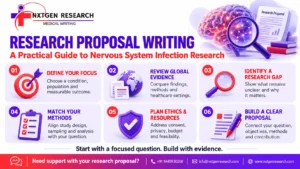
5. Identify a Research Gap You Can Address
Identifying a defensible gap is central to research proposal writing. The statement “few studies exist” needs supporting evidence.
A useful gap may concern inconsistent outcome measurements, limited follow-up or insufficient evidence about a particular population. However, these possibilities must be checked against the literature before being presented as established problems.
Explain three things: what remains uncertain, why that uncertainty matters and how your study could help resolve it.
For example, several studies might examine recovery at discharge, while your proposed question concerns outcomes at a later interval. You would need to demonstrate that the later outcome is insufficiently understood.
Effective research proposal writing makes the contribution specific. A smaller study answering a well-defined question may be more useful than a broad project with unclear objectives.
6. Consider Autonomic Outcomes Where Relevant
The autonomic nervous system helps regulate involuntary functions, including heart rate and blood pressure. It may be relevant when investigating particular neurological complications associated with infection.
WHO notes that Guillain–Barré syndrome can involve abnormal heartbeat and high or low blood pressure. These complications explain why cardiovascular monitoring may be important in affected patients. If your question concerns autonomic function, explain how it will be assessed. A reported symptom, questionnaire score and clinical measurement provide different information.
Consider alternative explanations for abnormal findings, including medication use, dehydration and pre-existing conditions. Discuss appropriate measurements with the clinical team.
Include autonomic outcomes when the evidence supports their relevance and your study can assess them reliably. Avoid expanding the proposal beyond what its objectives and resources can support.
7. Match Your Methods to Your Research Question
In research proposal writing, the methodology explains how the study will produce evidence capable of answering its central question.
A retrospective record review may suit an investigation of documented hospital outcomes. A prospective cohort can follow recovery over time. Interviews can explore experiences of care, while a systematic review can synthesise existing studies.
Define eligibility criteria and distinguish suspected, probable and confirmed infections where relevant. If identifying a particular microorganism is essential, specify the evidence required to establish that identification.
Choose a primary outcome and justify the sample size using the planned analysis or required precision. For qualitative research, explain the sampling rationale.
Strong research proposal writing also addresses missing information, potential confounders and likely sources of bias before data collection begins.
8. Plan for Ethics, Resources and Feasibility
Ethics and feasibility deserve attention throughout research proposal writing. Check access to participants, records, equipment and clinical expertise before finalising the design.
Estimate recruitment using available service information. Consider whether participants can realistically attend follow-up appointments and how missing visits will be handled.
Describe the required ethics review, consent arrangements, confidentiality protections and data access permissions. Where illness affects consent capacity, address the applicable institutional requirements.
Distinguish routine clinical procedures from additional research activities. Explain participant burden and how clinically concerning findings will be communicated.
Include realistic costs for assessments, travel, translation and data management. Your timetable should allow for approvals, recruitment, analysis and revisions. These details help reviewers assess whether the proposed work can be completed responsibly.
9. Keep Your Research Proposal Writing Clear and Consistent
Follow your institution’s required structure. Most proposals include the background, problem statement, literature review, research question, aim, objectives, methodology, ethical considerations, timeline, budget and references.
Keep these sections connected. The problem should lead to the question, and each objective should have a corresponding method.
Avoid promising findings before collecting data. State what you will examine, estimate or explore, and explain the possible contribution without guaranteeing a particular result.
Review terminology and references carefully. Make sure descriptions of populations, outcomes and follow-up periods remain consistent throughout the document.
Good research proposal writing allows a reviewer to follow one coherent argument: this question matters, the evidence leaves it unresolved, and the proposed methods offer a reasonable way to investigate it.
Preparing a proposal in this field? Contact NxtGen Research to discuss support with literature review writing, proposal structure and scientific editing. Share your topic, institutional guidelines and timeline, and develop your research decisions with your supervisor or clinical research team.
FAQ
1. How do I start research proposal writing on nervous system infections?
Start by selecting a specific condition, population and outcome. Review existing studies to identify an unanswered question, then assess whether you have the time, resources and access needed to investigate it. Use this foundation to develop your objectives and methodology.
2. How can global research strengthen my proposal?
Global research helps you compare findings, methods and patient populations across different settings. It can reveal questions worth investigating locally. Explain how differences in healthcare resources, diagnostic practices or follow-up arrangements might affect the relevance of international findings.
3. What should the literature review include?
Your literature review should evaluate relevant studies, compare their findings and methods, and explain their limitations. Effective literature review writing shows how the available evidence supports your research question. Record your search process and avoid claiming that a gap exists without checking the literature.
4. How do I identify a research gap in this field?
Look for unresolved questions, inconsistent measurements, underrepresented populations or limited follow-up data. Confirm the potential gap through a thorough literature search. Explain why addressing it matters and how your proposed study could contribute useful evidence.
5. Which research method should I choose?
Choose a method that matches your question. A record review can examine documented outcomes, a prospective cohort can follow recovery over time, and interviews can explore patient experiences. Your choice should also reflect data availability, ethical requirements and practical constraints.
6. What should I include in a research proposal?
Include a clear title, background, problem statement, literature review, research question, aim, objectives, methodology, ethical considerations, timeline, budget and references. Follow your institution’s required format and make sure each objective connects to a suitable method.