
Introduction
When researchers plan to publish their work in a journal, prepare research proposal planning and following appropriate reporting guidelines are important steps in producing a clear and reliable study. Clear reporting helps readers understand how the research was designed, how data were collected, and how the findings were interpreted.
A well-structured manuscript should clearly present the research question, methodology, results, limitations, and implications. Reporting guidelines provide researchers with a practical framework for presenting this information consistently and transparently.
Whether the study is a clinical trial, observational study, systematic review, or another type of healthcare investigation, selecting the appropriate reporting guideline can improve the quality and completeness of the manuscript. This approach also helps researchers prepare research proposal documents that are aligned with their study objectives and publication requirements.
1. Why Reporting Guidelines Matter in Healthcare Research
Reporting guidelines help researchers present their work in a complete, transparent, and consistent way. They reduce the possibility of important methodological details being overlooked and make published studies easier to evaluate and reproduce.
Before starting a project, researchers should understand which reporting framework applies to their study design. This decision is also useful when they prepare research proposal documents because the expected methodology, outcomes, and reporting requirements can be considered from the beginning.
Following established standards can strengthen the manuscript and make it easier for editors, reviewers, and readers to understand the research.
2. Prepare Research Proposal with a Clear Methodology
A strong proposal begins with clearly defined research objectives. When researchers prepare research proposal documents, they should explain the research question, study population, methodology, expected outcomes, and methods of analysis.
The proposal should demonstrate that the planned study is feasible and ethically appropriate. Clearly describing these elements at an early stage helps researchers maintain consistency when the study progresses to manuscript preparation.
Professional research support can help researchers organize their methodology and present the proposed work in a logical academic format.
3. Scientific Article Writing and Transparent Reporting
Scientific article writing requires more than presenting research findings. Authors need to explain how the study was conducted and provide enough information for readers to understand and assess the results.
A well-written article normally includes a clear introduction, methodology, results, discussion, and conclusion. Tables and figures should support the findings rather than simply repeat information already presented in the text.
Clear reporting also allows reviewers to assess whether the research methods adequately support the conclusions drawn by the authors.
4. Writing a Research Proposal for Journal-Based Research
Writing a research proposal gives researchers an opportunity to establish the direction of a study before data collection begins.
A good proposal should describe the research problem, objectives, study design, participant selection, data collection methods, and expected contribution. Where appropriate, researchers should also identify potential limitations and ethical considerations.
When authors prepare research proposal materials carefully, these elements can provide a useful foundation for developing the final manuscript.
5. Writing a Literature Review to Establish Research Context
A literature review provides the background needed to explain why a study is necessary. It identifies existing evidence, unresolved questions, and areas where additional research may be required.
Writing a literature review should involve more than summarizing previous publications. Researchers should compare findings, identify limitations in existing evidence, and explain how the proposed study addresses an identified need.
A focused review can strengthen the rationale for the study and help researchers develop meaningful research objectives.
6. Research Report and Manuscript Development
A clear research report should present the study in a logical sequence. Readers should be able to understand what was investigated, how the research was performed, what was discovered, and what the findings mean.
Authors should check whether the manuscript contains sufficient methodological details, appropriate references, clearly presented results, and an accurate discussion of limitations.
Careful manuscript refinement can improve readability while maintaining the scientific meaning of the research.
7. Understanding Publishing Journals Requirements
Different publishing journals have different requirements for manuscript structure, formatting, references, word counts, figures, tables, and reporting standards.
Authors should review the journal’s instructions before submitting their manuscript. They should also determine whether the journal recommends or requires a specific reporting guideline for their study type.
Following these requirements can prevent avoidable formatting problems and help authors prepare a submission that meets the journal’s expectations.
8. Research About Education and Reporting Standards
Research about education has highlighted the importance of training researchers to understand reporting standards and responsible research practices.
Students, early-career researchers, and healthcare professionals can benefit from learning how reporting guidelines apply to different study designs. Training can include research methodology, manuscript preparation, ethical considerations, and interpretation of published evidence.
Improving reporting knowledge at the education stage can help researchers develop better publication practices throughout their careers.
9. Systematic Review Journal and Reporting Requirements
Researchers conducting systematic reviews need to pay particular attention to reporting standards. A systematic review journal submission commonly requires transparent descriptions of the search strategy, eligibility criteria, study selection, data extraction, and synthesis methods.
PRISMA is widely used as a reporting framework for systematic reviews and meta-analyses. Authors should check the specific requirements of their target journal and apply the appropriate checklist during manuscript preparation.
Using a structured reporting approach helps readers understand how evidence was identified, assessed, and synthesized.
10. Journal of Scientific Reports and Editorial Compliance
A journal of scientific reports expects research articles to communicate methods and findings clearly. Authors should therefore check their manuscript for completeness before submission.
This includes reviewing the study design, methodology, statistical analysis, references, figures, tables, declarations, and supporting information.
Editorial requirements can vary between journals, so researchers should always consult the current author guidelines rather than relying on assumptions about formatting or submission procedures.
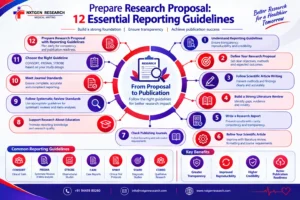
11. Common Reporting Guidelines Used in Healthcare Research
Different study designs require different reporting frameworks. Some of the most commonly recognized guidelines include:
- CONSORT – randomized controlled trials
- PRISMA – systematic reviews and meta-analyses
- STROBE – observational studies such as cohort, case-control, and cross-sectional studies
- CARE – case reports
- SPIRIT – clinical trial protocols
- STARD – diagnostic accuracy studies
- COREQ – qualitative research involving interviews and focus groups
Researchers should select the guideline that matches their study design rather than applying the same framework to every type of research.
12. Prepare Research Proposal with Reporting Guidelines
Researchers can strengthen their planning process by considering reporting requirements before the study begins. This approach allows important methodological details to be incorporated into the project from the outset.
When authors prepare research proposal documents with reporting standards in mind, they can establish clearer objectives, outcomes, methodology, and documentation procedures.
The same principles should continue through manuscript development, scientific article writing, and journal submission. Early planning can reduce the need for major revisions later.
Conclusion
Reporting guidelines provide researchers with a practical framework for presenting healthcare research clearly and transparently. They help authors communicate study methods, findings, limitations, and conclusions in a consistent manner.
From writing a research proposal to preparing the final manuscript, researchers should identify the appropriate reporting guideline for their study design and review the requirements of their target journal.
Researchers who prepare research proposal documents with appropriate reporting standards from the beginning can create a stronger foundation for manuscript development and publication.
Using recognized standards such as CONSORT, PRISMA, and STROBE can support transparent reporting and improve the overall quality of scientific communication.
FAQs
1.What are reporting guidelines in research writing?
Reporting guidelines are structured recommendations that help researchers describe study methods, results, and conclusions clearly and completely.
2.Why are reporting guidelines important in scientific publications?
They improve transparency, completeness, and reproducibility while helping reviewers and readers evaluate the quality of a study.
3.What is the CONSORT guideline?
CONSORT is a reporting guideline designed primarily for randomized controlled trials. It helps authors report important information about trial design, methodology, results, and participant flow.
4.What is PRISMA used for?
PRISMA is used mainly for systematic reviews and meta-analyses. It helps authors transparently report the search, screening, selection, and synthesis of evidence.
5.What is STROBE used for?
STROBE provides reporting recommendations for observational studies, including cohort, case-control, and cross-sectional studies.
6.How should researchers choose a reporting guideline?
Researchers should select the guideline according to their study design and then check the specific requirements of their target journal.