
Introduction
Cardiovascular health diet interventions are increasingly important in cardiovascular research, particularly when researchers need to understand how dietary patterns influence long-term health outcomes. A prospective cohort study can help researchers follow participants over time, evaluate cardiovascular risk factors, and assess outcomes using structured cardiovascular assessments.
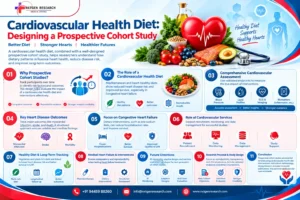
1.Importance of Prospective Cohort Studies in Cardiovascular Research
Prospective cohort studies track the subjects over a period of time, establishing risk factors and outcomes. In case, following patients with cardiovascular disease is a way to measure interventions like lifestyle change or drug therapy. There is reproducibility in the incorporation of cardiovascular health diet and planned cardiovascular evaluation. Peer reviewed journals require authors to perfect methodology. Such an organised method makes it stronger and credible and makes sure that manuscripts will add value to the future contribution of medical heart failure research and world cardiovascular services.
2.Cardiovascular Health Diet and Prospective Cohort Study Design
Intervention studies revolve around a cardiovascular health diet. As an illustration, in prospective cohorts of Mediterranean diets, the results that are evaluated include decreased heart disease and improved survival in congestive heart failure. Organized food intake is reproducible. The results are enhanced by including cardiovascular evaluation. Methodology has to be refined by the authors to meet the requirements of scientific research. Peer reviewed journals make it more credible and is guaranteed that manuscripts make a valuable contribution to the literature of cardiovascular disease and diet.
3.Cardiovascular Assessment in Prospective Cohort Studies
Interventions need to be evaluated through comprehensive cardiovascular assessment. As an example, prospective cohorts should contain validated endpoints like blood pressure, lipid profiles and echocardiography. CVD health diet integration enhances reproducibility. Methodology has to be refined by the authors to meet the requirements of scientific research. Peer reviewed publications also boost the credibility and purpose of meaning in the manuscripts to be published to the medical heart failure and international cardiovascular service.
4.Heart Disease Outcomes in Cohort Studies
Potential cohorts measure heart disease outcomes which include myocardial infarction, stroke, and death. There is reproducibility in the incorporation of cardiovascular health diet and planned cardiovascular evaluation. Methodology has to be refined by the authors to meet the requirements of scientific research. Writing in peer reviewed journals improves credibility and assures that the manuscripts are adding value to the knowledge on cardiovascular diseases. This systematic practice reinforces the evidence-based practice and educates the cardiovascular services worldwide.
5.Cardiovascular Health Diet and Congestive Heart Failure
Congestive heart failure needs to be assessed with prospective cohorts, which need to focus on dietary interventions. Indicatively, low sodium diets lower the hospitalization rates and enhance survival.
There is reproducibility in the incorporation of cardiovascular health diet and planned cardiovascular evaluation. Methodology has to be refined by the authors to meet the requirements of scientific research.
The peer reviewed journals are more credible and the manuscripts published in such journals are likely to make a valuable contribution in the medical heart failure literature.
The interventions in cardiovascular disease require prospective cohort studies to evaluate these interventions. They follow the participants throughout the course of time measuring outcomes like heart disease, heart failure and mortality.
A systematic design guarantees reproducibility, credibility and clinical relevance. The incorporation of cardiovascular health diet and the use of full cardiovascular assessment would fortify the findings and evidence-based practice.
6.Cardiovascular Services and Study Implementation
Prospective cohort studies receive strong cardiovascular services that provide the infrastructure, recruitment of the patients, and monitoring of the data. There is reproducibility in the incorporation of cardiovascular health diet and planned cardiovascular evaluation. Methodology has to be refined by the authors to meet the requirements of scientific research. Writing in peer reviewed journals improves credibility and assures that the manuscripts are adding value to the knowledge on cardiovascular diseases.
7.Healthy Diet for Heart Health and Longitudinal Tracking
Prospective cohorts are based on having a healthy dietary heart. As evidence, vegetarian diets decrease heart disease and survival in CHF. There is reproducibility in the incorporation of cardiovascular health diet and planned cardiovascular evaluation. Methodology has to be refined by the authors to meet the requirements of scientific research. Peer reviewed journals make it more credible and is guaranteed that manuscripts make a valuable contribution to the literature of cardiovascular disease and diet.
8.Medical Heart Failure and Cardiovascular Intervention Studies
Potential cohorts to test medical heart failure procedures need to focus on transparency and reproducibility. As an illustration, pharmacotherapy with cardiovascular health diet does enhance the outcomes. Reproducibility of cardiovascular assessment is achieved by structure. Methodology has to be refined by the authors to meet the requirements of scientific research. Writing in peer reviewed journals improves credibility and assures that the manuscripts are adding value to the knowledge on cardiovascular diseases.
9.Future Directions in Cardiovascular Cohort Studies
The future of the potential cohorts is AI-based monitoring, adaptive designs, and real-time cardiovascular evaluation. The inclusion of cardiovascular health diet enhances reproducibility. Methodology has to be refined by the authors to meet the requirements of scientific research. Peer reviewed journals make it more credible and is guaranteed that manuscripts make a valuable contribution to the literature of cardiovascular disease and diet.
10.Research Proposal Development for Cardiovascular Intervention Studies
Authors of research proposal need to focus on reproducibility, transparency, and clinical relevance to be able to prepare the research proposal in cardiovascular research properly.
An effective proposal incorporates validated endpoints, which include blood pressure and lipid profiles, and echocardiography into standard cardiovascular evaluation.
Prominence of dietary interventions such as a healthy diet to the heart makes it novelty and reinforce outcomes. Discussing the risk of congestive heart failure and providing long-term care of the cardiovascular disease helps achieve credibility.
Methodology and structured reporting of manuscripts are done with the assistance of professionals to meet the standards of publishing journals.
Through mastering of these aspects, researchers increase the chances of acceptance and provide value to their proposals by ensuring that they are significant to the medical science and the cardiovascular literature in the world.
11.Designing a Prospective Cohort Study with Cardiovascular Assessment
In the development of a prospective cohort study on cardiovascular intervention, investigators have to focus on reproducibility, transparency, and clinical relevance.
The validated endpoints that should be included in a structured cardiovascular assessment are blood pressure, lipid profiles, and echocardiography.
The inclusion of a healthy diet to support the heart into the study design makes its outcomes novel and strengthened.
Handling the risks of congestive heart failure and long-term management of the cardiovascular disease makes it more credible.
Manuscripts are also presented according to the standards of publishing journals and this is done through professional methodology and organized reporting.
Through the control of these aspects, investigators can enhance the probability of acceptance and make their proposals meaningful to the medical science and the world literature of cardiovascular diseases.
Conclusion
Prospective cohort studies provide a valuable approach for evaluating cardiovascular health diet interventions and their relationship with cardiovascular outcomes. By combining structured cardiovascular assessment, reliable methodology, and long-term follow-up, researchers can produce credible evidence for cardiovascular disease and heart failure research.
FAQs
1.What is a prospective cohort study in cardiovascular research?
It is longitudinal, involving non-randomized participants to study cardiovascular health diet and outcome using structured cardiovascular assessment techniques.
2.How to design a prospective cohort study for cardiovascular disease?
Insert validated endpoints, incorporate cardiovascular dietary health, and undertake reproducible cardiovascular assessment in order to get credible heart disease results.
3.How to write a prospective cohort study for a PhD dissertation?
Stress methodology, combination of cardiovascular health diet, and stress the importance of formal cardiovascular evaluation as a congestive heart failure research legitimacy.
4.What are examples of prospective cohort studies in cardiovascular research?
Research on cardiovascular health diet and long-term cardiovascular assessment outcome lowers risks of cardiovascular disease, as well as medical heart failure.
5.How to frame research objectives for cohort studies?
Clarify definitive destinations, incorporate cardiovascular health diet, and focus on reproducible cardiovascular evaluation to bring effective cardiovascular services.
6.How to publish a prospective cohort study in medical journals?
Write manuscripts containing systematic cardiovascular health diet information, approved cardiovascular evaluation and submit to top peer review journals.