Artificial Intelligence is transforming the way researchers approach scientific discovery, data analysis and healthcare innovation. From identifying potential drug candidates to analysing medical images and processing complex biological datasets, Artificial Intelligence is creating new opportunities across biotechnology and healthcare.
However, as these technologies become increasingly important, researchers face a major challenge: ensuring reproducibility. Research findings are valuable only when other researchers can understand the methods, follow the same procedures and obtain consistent results under comparable conditions.
In Artificial Intelligence-driven research, reproducibility can be affected by differences in datasets, algorithms, model configurations, software environments and validation procedures. This is where experienced freelance experts can make a difference. Their technical and scientific knowledge can help research teams improve analytical workflows, document methodologies and strengthen the reliability of their findings.
1.Understanding the Importance of Reproducibility in Artificial Intelligence Research
Reproducibility is a key foundation of reliable and transparent scientific research. It refers to the ability to obtain consistent results by following documented research methods and experimental procedures.
In Artificial Intelligence research, achieving reproducibility can be challenging because machine learning models depend on several interconnected components, including:
- Training and validation datasets
- Data preprocessing techniques
- Model architecture and parameters
- Software libraries and computing environments
- Random seeds and training configurations
- Evaluation metrics and validation procedures
Even small differences in these components can influence model performance.
For example, two research teams analysing the same medical imaging dataset may obtain different results if they use different preprocessing methods or model configurations. Proper documentation and standardised workflows help researchers identify these differences and evaluate findings more accurately.
2.The Growing Role of Artificial Intelligence in Biotechnology and Healthcare
The application of Artificial Intelligence in biotechnology and healthcare is expanding as researchers adopt advanced computational techniques to address complex biological and medical challenges.
Some important applications include:
Drug Discovery and Development: Artificial Intelligence can help researchers identify potential drug candidates, analyse molecular interactions and prioritise compounds for further investigation.
Medical Imaging: AI-based techniques can assist in analysing radiology, pathology and other medical images to identify patterns and support diagnostic research.
Genomics and Bioinformatics: Artificial Intelligence can process large biological datasets, identify genetic patterns and support the interpretation of genomic information.
Personalised Medicine: Researchers can use data-driven methods to investigate how individual patient characteristics influence treatment responses.
Clinical Research: Artificial Intelligence tools can support patient data analysis, risk prediction and the identification of patterns across clinical datasets.
These developments demonstrate the growing importance of biotechnology in healthcare. However, reliable outcomes depend on data quality, appropriate validation and transparent research methodologies.
3.Why Reproducibility Remains a Challenge in Artificial Intelligence Research
Despite technological progress, researchers continue to face several obstacles when attempting to reproduce Artificial Intelligence-driven findings.
Inconsistent Data Sources
Research datasets may contain missing values, duplicated records, inconsistent formats or variations in data collection procedures. These differences can affect model training and evaluation.
Limited Methodological Documentation
Some studies do not provide sufficient information about preprocessing steps, model parameters, software versions or training configurations. Without these details, repeating the experiment becomes difficult.
Model Complexity
Advanced machine learning and deep learning models may contain multiple layers and interconnected parameters. Understanding how these components influence results requires specialised technical knowledge.
Computational Limitations
Different hardware configurations, software dependencies and computing environments may produce variations in model behaviour or experimental outcomes.
Insufficient Validation
A model that performs well on one dataset may not achieve similar results when tested using an independent dataset. External validation is important for evaluating its generalisability.
Addressing these challenges requires technical expertise, scientific understanding and consistent documentation.
4.How Freelance AI Experts Support Reproducible Research
Freelance AI experts can provide specialised support to biotechnology and healthcare research teams without requiring organisations to maintain every technical skill internally.
Depending on project requirements, their contributions may include:
Data Preparation and Quality Assessment
Freelance data specialists can review datasets, identify inconsistencies, document preprocessing procedures and establish appropriate data quality checks.
AI Model Development and Validation
Experienced professionals can assist with model selection, parameter configuration, performance evaluation and validation using suitable datasets.
Bioinformatics Support
Bioinformatics specialists can help researchers process genomic, molecular and other biological datasets using appropriate computational methods.
Workflow Documentation
Experts can document analytical workflows, software dependencies, model configurations and experimental procedures. This makes it easier for other researchers to understand and repeat the work.
Statistical Analysis
Statistical specialists can support the selection of appropriate evaluation metrics, assess model performance and help interpret research findings.
These contributions can improve transparency and organisation while allowing research teams to concentrate on their scientific objectives.
5.The Importance of Bioinformatics in Biotechnology Research
Bioinformatics connects biological research with computational analysis. Modern biotechnology projects often generate large datasets involving DNA sequences, gene expression, proteins and molecular interactions.
Interpreting this information involves combining biological expertise with advanced computational methods.
Artificial Intelligence-assisted bioinformatics can help researchers:
- Identify patterns in genomic datasets.
- Analyse gene expression and molecular relationships.
- Explore potential disease-associated biomarkers.
- Support drug target identification.
- Interpret large-scale biological information.
However, reliable results depend on appropriate analytical pipelines, documented data sources and suitable validation methods.
Collaboration with experienced bioinformatics professionals can help research teams establish more organised and transparent workflows, particularly when working with complex biotech health datasets.
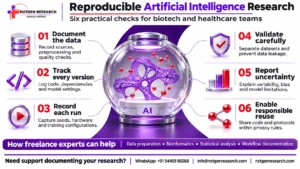
6.Best Practices for Improving Reproducibility
Research teams can introduce several practical measures to improve reproducibility in Artificial Intelligence-based biotechnology and healthcare studies.
Maintain Detailed Documentation: Record data sources, preprocessing methods, model architectures, parameters and software versions.
Use Version Control: Maintain trackable versions of datasets, scripts, analytical pipelines and model configurations.
Establish Standardised Workflows: Apply consistent procedures for data preparation, model training and performance evaluation.
Validate Using Independent Datasets: Where appropriate, test models using external datasets to assess whether findings extend beyond the original research sample.
Share Research Materials Responsibly: Make code, protocols and supporting information available when ethical, legal, privacy and institutional requirements permit.
Report Limitations Transparently: Explain dataset limitations, potential biases, model constraints and uncertainties in research findings.
These practices support research transparency and make scientific results easier to evaluate and reproduce.
7.Choosing the Right Freelance Experts for Healthcare Research
Selecting suitable professionals is important when working on complex Artificial Intelligence and biotechnology projects.
Before engaging freelance experts, research teams should consider:
- Technical Experience: Familiarity with machine learning, deep learning, statistical analysis and relevant AI technologies.
- Domain Knowledge: Understanding of healthcare, biotechnology, medical research or biological datasets.
- Research Experience: Experience with scientific methodologies, research publications and data interpretation.
- Documentation Skills: Ability to explain analytical procedures and model configurations clearly.
- Data Security Awareness: Understanding of confidentiality, patient privacy and responsible research data handling.
The right combination of technical and scientific expertise can help research teams address reproducibility challenges more effectively.
Conclusion: Building More Reliable Artificial Intelligence-Driven Research
Artificial Intelligence continues to create new possibilities in biotechnology and healthcare. However, technological innovation must be supported by transparent methodologies, reliable datasets and reproducible analytical workflows.
From data preparation and bioinformatics to model validation and research documentation, freelance experts can provide valuable specialised support throughout the research process.
Ultimately, reproducibility is not simply a technical requirement. It is an essential part of building trust in scientific findings and supporting responsible innovation in healthcare.
By combining Artificial Intelligence technologies with appropriate research practices and specialised expertise, researchers can improve the transparency, reliability and scientific value of their work.
Working on an Artificial Intelligence-driven biotechnology or healthcare research project?
NxtGen Research supports researchers with medical writing, research documentation, statistical analysis and publication-related services.
🌐 Website: https://nxtgenresearch.com/
📧 Email: info@nxtgenresearch.com
📞 Contact: +91 94459 80260
FAQ
1.What is the role of Artificial Intelligence in medical research?
Artificial Intelligence supports medical research through data analysis, medical imaging, disease prediction, drug discovery and the interpretation of complex clinical and biological information.
2.Why is reproducibility important in Artificial Intelligence research?
Reproducibility helps researchers verify findings, understand research methods and assess whether results can be obtained under comparable experimental conditions.
3.How can freelance AI experts support biotechnology research?
Freelance AI experts can assist with data preparation, model development, bioinformatics, statistical analysis, validation and research workflow documentation.
4.What is the role of bioinformatics in healthcare?
Bioinformatics combines biological knowledge and computational techniques to analyse genomic, molecular and other biological datasets. It supports research into diseases, biomarkers and potential treatments.
5.How can researchers improve reproducibility in AI-driven studies?
Researchers can improve reproducibility through detailed documentation, version control, standardised analytical procedures, independent validation and transparent reporting of research limitations.
6.What factors should researchers consider when selecting AI tools for biotechnology and healthcare research?
Researchers should evaluate the accuracy, reliability, data compatibility, validation capabilities and transparency of AI tools. Selecting suitable technologies that meet research objectives and follow data privacy requirements can help improve the quality and reproducibility of research findings.