
AI in research can help teams explore what happens after a paper is published. The work may attract citations, appear in a policy report or contribute to changes in professional practice. These forms of influence require different evidence. A citation count shows that other publications referenced the work, but it does not explain how they used it or whether anyone benefited.
1.Define What Research Impact Means for Your Project
Before selecting a tool, decide what you want to understand.
Are you investigating whether other researchers adopted your method? Whether your findings informed a policy discussion? Or whether a service changed after your research was introduced?
These questions require different evidence. Academic influence might involve citations, method reuse or subsequent investigations. Wider impact could involve documented changes in policy, practice or public understanding.
Using AI in research impact assessment should begin with a specific question. For example:
“Where has our screening study been discussed, and what evidence shows that its findings informed later decisions?”
This gives the assessment a clearer purpose than simply asking an AI system to calculate an impact score.
2.Look Beyond the Number of Citations
Two papers with the same citation count may have influenced later work in different ways. One might provide background information. Another might introduce a method that subsequent researchers use directly.
One useful application of AI in research is analysing the text around citations to help explain how later publications use earlier findings.
Semantic Scholar, for example, classifies citation intent into background, method and result-extension categories. Its citation-intent information depends on access to the citing paper’s full text. The platform also uses machine learning to identify potentially influential citations.
These features can help researchers prioritise which citing papers to read. The classifications should still be checked against the original passages, especially when they support an important claim about research influence.
3.Use Bibliometric Analysis to Explore Connections
Bibliometric analysis helps researchers understand how publications are connected through citations, shared topics and collaboration. It can help researchers explore who cites a body of work, which institutions collaborate and how topics develop over time.
AI in research can support bibliometric analysis by grouping abstracts according to their subject matter. Researchers can then examine citation connections between these groups and check whether the patterns reflect meaningful links.
For example, a team could investigate whether a measurement technique developed in one discipline appears in research from another.
The distinction matters: a conventional citation network is not automatically an AI application. Explain which tasks involve machine learning and which involve ordinary counting, filtering or visualisation.
Review the grouped papers before interpreting a pattern as meaningful knowledge transfer.
4.Investigate Influence Beyond Academic Journals
Research does not circulate only through journal articles. Policy documents, professional reports and organisational guidance may also discuss findings.
Resources such as Overton help identify references to research within indexed policy documents. Its guidance recommends examining the qualitative evidence behind these connections and recognising that its collection does not represent every policy document. Coverage and reference-matching limitations can affect the results.
Using AI in research assessment can help teams screen large collections of policy documents and professional reports for potential mentions. Each important match still needs verification against the original source.
A paper cited in a policy report may have informed its background discussion without changing a recommendation. Describe the documented connection accurately rather than presenting every mention as proof of policy change.
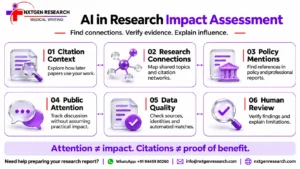
5.Separate Public Attention from Demonstrated Impact
News stories, online discussions and social media posts can show that research has attracted attention. They do not necessarily establish that the work is reliable or has produced a practical benefit.
Altmetric explicitly describes its data and Attention Score as indicators of attention, rather than measures of research quality or impact.
When using artificial intelligence in research communication analysis, a team might group mentions by topic or identify questions raised by different audiences.
That can reveal useful leads. For instance, repeated discussion among patient organisations could justify investigating how the findings were understood.
The next step is to examine those discussions directly. Automated sentiment labels alone cannot establish whether an audience understood, trusted or used the research.
6.Apply These Distinctions Carefully in Health Research
In health research, the distance between publication and practical benefit deserves particular attention.
Consider a hypothetical study evaluating an appointment-reminder approach. AI in research assessment could help locate later papers, service reports and guidance documents discussing the study, giving the team relevant sources to investigate.
Those documents could show that others considered or tested the approach. They would not, by themselves, demonstrate improved attendance or better patient outcomes.
A stronger assessment would look for implementation records, evaluations and explanations from the organisations involved.
The contribution of the original study should also be considered alongside other evidence and local decisions. Research usually informs change through several connected activities, making simple claims of sole responsibility difficult to support.
7.Check Data Quality When Using AI in Research
AI in research relies on the information available to it. Missing publications, incorrect author matches and incomplete citation records can produce an inaccurate picture.
Before analysis, check titles, publication identifiers, affiliations and duplicate records. Record which databases were searched and when the information was collected.
Then inspect a sample of the automated results. Does a claimed citation refer to the correct paper? Does a topic label reflect the content? Can every important summary be traced to a source?
For AI-generated summaries, retain the supporting passages alongside the output. This makes it easier to identify unsupported statements and correct mistakes before they enter an impact report.
8.Keep Research Evaluation Fair and Transparent
Comparisons need context. Research fields differ in publishing practices, citation patterns and the time required for findings to influence later work.
An assessment should therefore explain its scope, indicators and limitations. Avoid treating a single score as a complete description of a researcher’s contribution.
DORA’s guidance recommends clarity, transparency, specificity, context and fairness when using quantitative indicators. It also emphasises that quantitative information should support qualitative assessment rather than lead it.
For research evaluation, document how automated classifications were checked and how disputed results can be corrected.
A transparent process allows readers to judge the evidence instead of having to trust an unexplained ranking.
Build an Evidence-Based Account of Research Influence
The most useful role of AI in research is to help people find and organise evidence that would otherwise be difficult to examine at scale.
Start with a defined assessment question. Select suitable sources, check the records, review automated findings and investigate the most relevant connections. Keep attention, academic influence and demonstrated practical outcomes distinct throughout the process.
The final report should explain what happened, what evidence supports it and what remains uncertain. A clear account of a modest contribution is more credible than an impressive score with little explanation.
Preparing a research manuscript or report? Contact NxtGen Research with your topic, available evidence and deadline to discuss research writing, editing and reporting support.
FAQ
1. How does AI help assess research impact?
AI can help organise publications, analyse citation contexts and identify mentions in policy documents or public discussions. These findings provide leads for investigating research influence. Researchers still need to verify the sources and explain what the evidence supports.
2. Can AI determine whether a research paper is high quality?
AI-generated scores alone cannot establish research quality. Assessing a paper requires examining its methods, data, analysis and conclusions. Automated tools can support this process, but their outputs need expert interpretation.
3. What is the difference between citation counts and research impact?
Citation counts show how often indexed publications reference a paper. Research impact concerns how the work contributes to knowledge, policy, practice or other outcomes. Understanding that contribution requires examining how the research was used, rather than counting references alone.
4. How does AI support bibliometric analysis?
AI can help classify publications by topic and analyse the text surrounding citations. Combined with bibliometric analysis, these techniques can help researchers explore connections across disciplines and bodies of work. However, ordinary citation counting and network mapping do not necessarily involve AI.
5. Can AI identify the practical impact of health research?
AI can help locate publications, guidance and reports that discuss health research. These references may indicate possible influence, but they do not prove improved patient outcomes. Demonstrating practical benefits requires additional evidence, such as implementation records and service evaluations.
6. What should researchers check before using AI-generated impact findings?
Researchers should verify publication identities, citation matches, source coverage and the accuracy of summaries. They should also document the tools and collection dates, examine possible biases and distinguish public attention from demonstrated outcomes. Important claims should remain traceable to their original evidence.