You type your research topic into a search box and receive thousands of results. Some look useful, others barely relate to your question, and several ask you to pay before reading. Where should you begin?
Finding a scholarly article becomes easier when you know what you need, where to search and how to assess the results. The aim is to find evidence that helps you understand your topic and support your discussion.
Whether you are preparing an assignment, research proposal or dissertation, the following steps will help you search with a clearer purpose.
1. Understand what makes an article scholarly
A scholarly article presents research, analysis or an evidence-based discussion for an academic audience. It usually identifies its authors, explains the subject in detail and acknowledges earlier work through references.
An original research article commonly includes an introduction, methods, results and discussion. However, review papers and theoretical articles may follow different structures.
Look for features such as:
- Named authors and their institutional affiliations.
- A clearly stated purpose or research question.
- An explanation of the evidence or methods used.
- References supporting the discussion.
- Publication details, including the journal name and date.
These features help you recognise academic material, but appearance alone does not establish quality. A professional-looking PDF still needs careful evaluation.
Also, “scholarly” and “peer reviewed” are not interchangeable. Check the publication process when your assignment specifically requires peer reviewed articles.
2.Turn your topic into a focused search
A broad topic often produces broad results.
For example, searching for “student health” could bring up papers about nutrition, sleep, exercise, stress or healthcare access. You will have more direction if you identify the particular issue you want to understand.
A focused starting point might be:
How is sleep quality associated with academic performance among university students?
You can then separate the question into three concepts:
|
Main concept |
Possible search terms |
|---|---|
|
Population |
University students, college students |
|
Sleep |
Sleep quality, sleep duration |
|
Outcome |
Academic performance, academic achievement |
You do not need a perfect search question immediately. Start with wording that reflects your needs, then refine it as you discover how researchers describe the topic.
3.Choose a suitable place to search
Your university library website is a useful starting point. Look for subject guides, recommended resources and access instructions.
Different tools serve different purposes:
|
Resource |
How it can help |
|---|---|
|
Google Scholar |
Discover academic material across disciplines |
|
PubMed |
Find biomedical and life-science literature |
|
Web of Science |
Search indexed literature and explore citation connections |
|
University library search |
Locate material available through your institution |
Google Scholar includes journal papers alongside books, dissertations, conference papers and preprints. Its results therefore need checking before you treat them as published, peer-reviewed evidence.
PubMed provides search tools and filters for biomedical literature, while Web of Science includes several citation indexes. Choose according to your subject and the purpose of your search.
For a systematic review, follow an appropriate search protocol rather than relying on a single convenient source.
4.Use Google Scholar with a clear purpose
When looking for Google Scholar articles, begin with a few meaningful terms rather than typing your entire assignment title.
For the example above, try:
“sleep quality” “university students” “academic performance”
Review the titles and short descriptions. If the results are too narrow, remove one phrase or try an alternative term.
Google Scholar offers date restrictions, related-article links and citation connections. Its “Cited by” feature can help you locate later work that refers to a useful paper. You can also search a known article title in quotation marks.
Treat these features as ways to discover material. A high citation count does not establish that a scholarly article answers your question or that its conclusions are reliable.
Read the source before deciding how to use it.
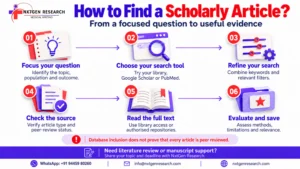
5.Combine terms and refine your results
Many academic databases let you combine search terms using Boolean operators.
Use OR between alternatives and AND between different concepts. For example:
(“university students” OR “college students”)
AND
(“sleep quality” OR “sleep duration”)
AND
“academic performance”
This is a starting search, not a complete strategy. Search syntax varies between platforms, so check the database’s help page.
After examining the results, consider whether date, language or article-type filters would improve relevance. PubMed, for example, provides filters for publication date and article type.
Apply restrictions for a reason. A recent date range may suit a rapidly changing topic, but it can also remove foundational studies. Keep a record of the filters you use.
6.Confirm whether the article was peer reviewed
Searching for a peer reviewed articles database is understandable, but database inclusion alone does not confirm the status of every document.
Check the journal’s editorial policy and the article type. Journals may publish original research alongside editorials, letters, news items and other material with different review processes.
The National Library of Medicine explains that PubMed does not provide a filter limiting results to peer-reviewed journals. It recommends checking a journal’s editorial information or asking the publisher about its policy.
Preprints also require attention. They make research available before journal peer review and should be identified accordingly.
If your course requires peer reviewed articles, confirm that each selected source meets that requirement. Ask your librarian when the publication information is unclear.
7.Understand what indexing tells you
You may encounter the term Science Citation Index while searching for scientific articles or checking journal information.
Clarivate’s Science Citation Index Expanded, or SCIE, is a multidisciplinary science index within the Web of Science Core Collection. The Master Journal List identifies journals covered by Clarivate’s indexes.
If your institution requires a particular index, check the journal’s exact title and ISSN, then confirm the relevant collection and coverage information.
Indexing is useful context, but it does not replace reading the paper. An indexed scholarly article can still have methodological limitations or address a different population from the one you are studying.
Judge its relevance and evidence separately.
8.Find the full text before paying
An abstract can help you decide whether a paper looks relevant. It rarely provides enough detail to assess the methods, results and limitations properly.
Before purchasing access, try:
- Signing in through your university library.
- Checking the publisher’s open-access options.
- Looking for an authorised repository copy.
- Asking your librarian about document delivery or interlibrary loan.
Google Scholar may display PDF links, library access links or alternative versions. Check whether the available document is a preprint, accepted manuscript or published version.
If you use a different version, note its status and check for meaningful changes in the published paper where possible.
9.Read critically and save useful notes
Once you find a promising scholarly article, ask what it contributes to your work.
Does it examine the right population or setting? Are the methods suitable for the question? Do the findings support the authors’ conclusions? What remains uncertain?
Look for corrections or retraction notices on the publisher’s page. Avoid assuming that publication or peer review removes the need for critical reading.
Save the reference details together with a short note explaining why the paper matters. Record its purpose, methods, main findings and limitations.
Keep direct quotations separate from your own summaries. Also record your search terms and search date so you can repeat or update the search later.
Find evidence you can explain and use
Finding a scholarly article is the beginning of the research process. Its value depends on how well you understand it, assess its limitations and connect it to your question.
Start with a focused topic, use suitable search tools and check each source before citing it. A smaller collection of carefully evaluated papers can support a stronger discussion than a large folder of unread downloads.
Preparing a literature review or manuscript? Contact NxtGen Research with your topic, current draft and deadline to discuss research-writing guidance, editing and manuscript preparation support.
FAQ
1. What is a scholarly article?
A scholarly article presents research, analysis or an evidence-based discussion for an academic audience. It usually includes author details, references and a clear explanation of its subject. Original research papers commonly describe their methods, findings and limitations.
2. Where can I find scholarly articles?
Start with your university library, Google Scholar or a database relevant to your discipline. PubMed is useful for biomedical literature, while Web of Science covers multiple research areas. Choose resources that match your topic and check each article’s relevance before using it.
3. Are all Google Scholar articles peer reviewed?
No. Google Scholar includes journal papers, dissertations, books, conference papers and preprints. Appearing in its results does not confirm peer review. Check the article’s publication status and the journal’s editorial policy before treating it as peer-reviewed evidence.
4. How can I check whether an article is peer reviewed?
Visit the journal’s official website and read its peer-review policy. Also check the document type, because research papers, editorials and letters may undergo different review processes. If the information is unclear, ask your librarian or contact the publisher.
5. Can I access a scholarly article for free?
Many scholarly articles are available through open-access journals, university repositories or subject repositories. Your institution may also provide subscription access. Check library links and authorised copies before paying, and confirm whether you are reading a preprint, accepted manuscript or published version.
6. How do I know whether a scholarly article is suitable for my research?
Check whether its question, population, setting and methods relate to your project. Read the full text to assess the evidence and limitations. A recent publication date, high citation count or database listing alone does not establish that the article is suitable.