
If you are planning a PhD in public health, you may have heard that you need three published papers before you can graduate. Someone else might tell you that one article is enough. Both statements leave out the detail that matters most: which university, programme and dissertation route are they describing?
There is no single article requirement that applies to every programme. Some programmes offer a dissertation built around several manuscripts, while others allow a traditional thesis. Requirements may also distinguish between papers that are ready for submission, submitted, accepted or published.
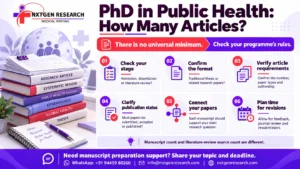
Before setting yourself a publication target, establish exactly what your department expects. Here is how to interpret those expectations and build a realistic writing plan.
1.First, clarify what you mean by “articles”
The question can refer to three different things:
- Articles published before admission: Evidence of previous research experience.
- Articles produced during the doctorate: Manuscripts associated with your dissertation.
- Articles included in your literature review: Sources you read, evaluate and cite.
These are separate requirements. Publishing a paper does not automatically satisfy a dissertation requirement, and reading a large number of papers does not establish that your literature review is complete.
For a PhD in public health, start by identifying the stage you are asking about. Are you preparing an application, planning your doctoral research or checking whether you are ready to submit?
Once you know whether you’re checking admission or graduation requirements, you can look at the right section of your programme’s guidelines.
2.Check your programme’s dissertation requirements
University examples show why a general answer can be misleading.
Yale School of Public Health allows a monograph or a collected-paper dissertation. Its guidance describes the latter as typically involving at least three first-authored scientific papers, with one or more published, accepted or submitted. The papers must form a coherent body of research.
UC San Diego’s guidance for its public health doctorate in Health Sciences Research and Implementation Science describes a preferred approach involving three or more published or submitted empirical manuscripts. It also provides a traditional dissertation option where the research is unsuitable for the three-paper format.
These examples illustrate different routes; they do not establish a worldwide minimum.
Read the handbook that applies to your programme and intake. If departmental guidance and university regulations appear inconsistent, ask the programme director to clarify which requirements apply to you.
3.Understand publication status before setting deadlines
Your programme may ask for three manuscripts without requiring all three to be published before you graduate.
|
Status |
What it means |
|
Drafted |
A manuscript has been written but may need further work. |
|
Submitted |
A journal has received the manuscript. |
|
Under review |
The manuscript is being evaluated; acceptance remains uncertain. |
|
Accepted |
The journal has formally accepted the manuscript. |
|
Published |
The article has appeared online or in a journal issue. |
Your department may accept one status while requiring another for a particular milestone.
When planning a PhD in public health, ask whether the requirement applies before your defence, final dissertation submission or degree award. Also check whether first authorship is necessary and whether review articles count.
Keep written confirmation of the answer. It is much easier to plan around a clear rule than to resolve uncertainty shortly before graduation.
4.Check admission expectations separately
If you have not yet started your doctorate, do not apply dissertation publication rules to your application.
Look for an explicit publication requirement on the admissions page. Where publications are not listed as compulsory, avoid assuming that you must publish simply because another applicant has done so.
For example, Berkeley Public Health’s admissions guidance lists several possible forms of writing samples, including written assignments, reports and journal articles. Check the requirements for the specific programme you plan to apply to. A writing-sample request therefore does not automatically mean a published-paper requirement.
If you are completing a master’s in public health, discuss whether your dissertation could become a worthwhile manuscript. Consider the strength of the question, the available evidence and your contribution before deciding to submit it.
A rushed publication should not replace careful preparation of your doctoral application.
5.Plan a connected dissertation, not a collection of papers
An article-based dissertation needs a clear relationship between its parts.
Imagine a hypothetical project investigating why adults miss hypertension follow-up appointments. One paper might examine attendance patterns, another explore patients’ experiences, and a third evaluate a proposed service improvement.
Each paper would address a different question within the same broader problem. Whether this structure is acceptable would still require committee approval.
For your PhD in public health, discuss how each proposed manuscript contributes to the dissertation’s central argument. Avoid creating separate papers merely by dividing a dataset into smaller pieces without a meaningful research purpose.
Writing research articles becomes more manageable when you can explain what each paper establishes and why the complete set matters.
6.Build your literature review around coverage and relevance
The number of sources in a dissertation literature review is a different issue from the number of manuscripts you must produce.
Begin with the purpose of the review: explaining the problem, assessing existing evidence and showing why your research is needed.
Your reading may need to cover:
- The population and setting you are studying.
- Relevant theories or conceptual frameworks.
- Methods used in previous investigations.
- Findings that agree or conflict.
- Limitations your proposed study will address.
Do not add articles simply to increase the reference count. Equally, do not stop at an arbitrary number while important evidence remains unexplored.
For a systematic review, the number of included studies should follow the search and eligibility criteria. Discuss the expected scope and review approach with your supervisor.
7.Choose journals that fit the research
Selecting a peer reviewed journal involves more than finding somewhere that accepts your topic.
Examine its aims and scope, recent articles, author instructions, editorial information and publication charges. Ask whether its readers are likely to use your findings.
For example, a study about implementing a vaccination service may appeal to a different readership from a paper introducing an epidemiological method.
For a PhD in public health, confirm whether your institution imposes specific journal eligibility requirements. Do not assume that a journal’s visibility or reputation automatically satisfies those rules.
Discuss authorship and submission plans with your coauthors early. Make sure everyone understands their responsibilities, the intended journal and any costs before submission.
8.Create a writing plan with room for revision
Publication schedules involve work that is easy to overlook.
Alongside analysis and drafting, allow time for supervisor feedback, coauthor review, journal formatting, editorial decisions and revisions. A manuscript may also need submission to another journal.
Create a simple tracker showing:
- The research question for each paper.
- Data and analysis readiness.
- Drafting responsibilities.
- Internal review dates.
- Intended journal.
- Current submission status.
Update the tracker during supervisory meetings. If one paper falls behind, discuss the consequences early rather than allowing the delay to remain hidden.
Writing research articles alongside dissertation development can help you identify weaknesses in the argument while there is still time to address them.
Set the right target for your PhD in public health
The useful question is not simply, “How many articles should I have?” It is, “What research outputs does my programme require, and what must their status be when I submit?”
Confirm the dissertation format, manuscript count, authorship rules and publication milestones. Then build a plan that gives each paper a clear purpose within your research.
Your goal is to produce a defensible contribution to public health knowledge while meeting your programme’s requirements.
Preparing your dissertation or journal manuscript? Contact NxtGen Research
with your topic, university guidelines, current draft and deadline to discuss research-writing guidance, editing and manuscript preparation support.
FAQ
How many articles are required for a PhD in public health?
There is no universal number. Your programme determines the manuscript count, dissertation format and required publication status. Check the handbook for your intake and confirm the requirements with your supervisor.
Do all my papers need to be published before I graduate?
Not necessarily. Some programmes accept submitted manuscripts, while others require acceptance or publication for particular milestones. Confirm what status each paper must reach before your defence or final submission.
Do I need published articles before applying for a PhD in public health?
Published articles are not a universal admission requirement. Read the requirements for your chosen programme carefully. A request for a writing sample may allow an academic assignment, research report or unpublished manuscript.
Can a review article count towards my doctoral requirements?
It may count if your programme permits that article type and your committee approves its contribution. Check whether the requirements specify original empirical research, allow review papers or require a particular combination.
How many sources should my dissertation literature review include?
There is no single reference count suitable for every dissertation. Include enough relevant evidence to explain your topic, assess previous findings and justify your research question. Agree on the review’s scope with your supervisor.
Do I need to be the first author on my dissertation papers?
Some programmes require first authorship on papers included in the dissertation. Confirm the authorship rules early, discuss responsibilities with your coauthors and document your contribution to each manuscript.