
Finding articles and books for your discipline can take longer than expected. You start with a few search terms and soon have thousands of results to sort through. This guide walks you through choosing suitable databases, refining your searches and deciding which sources belong in your research.
1. Give Your Search Focus
Before opening any databases, finish this sentence: “I need to understand…”
Whatever comes next in your sentence becomes the starting point for your search. It doesn’t have to be a fully formulated research question. It simply needs to identify the scope of your task.
“I need to understand diabetes” is a start, but it leaves your search too broad. “I need to understand the barriers to medication adherence among adults with type 2 diabetes” is better because it narrows your field of view.
A focused question makes it easier to distinguish relevant research articles from unrelated results. Instead of spending hours reviewing articles that barely address your topic, you can concentrate on scientific articles that contribute directly to your research question.
If you’re unfamiliar with the subject, give yourself time to read the basics before diving into the research. A textbook section or review article can help you understand the fundamentals before you start evaluating individual publications.
Once you have a clearer understanding of the topic, you can refine your search and identify academic articles that provide useful background information and evidence.
2. Choose a Relevant Resource
Your university library’s subject pages can give you some direction on which databases and resources to use. They may also help you identify the research materials available through your institution.
Most of the resources below can help you find journal articles, but each one focuses on a different discipline.
|
Category |
Possible Resource |
|
Medicine and the life sciences |
PubMed |
|
Electrical engineering, computers, and mathematics |
IEEE Xplore |
|
Education |
ERIC |
|
Humanities and social sciences |
JSTOR |
|
Books |
WorldCat |
PubMed contains biomedical citations, while IEEE Xplore covers journals, conference publications, books, and technical standards in electrical engineering and computer science. ERIC focuses on education, while JSTOR provides access to journals, books, and other resources in the humanities and social sciences. WorldCat allows you to search the collections of libraries to locate books.
Your research question may cross disciplinary boundaries, particularly if you’re exploring an emerging technology in a medical setting. In such cases, relying on a single database may limit the range of research articles you find.
Take the time to search each relevant resource. Different databases index different publications, so the same search terms may produce different results. Exploring multiple sources can help you discover scientific articles, peer reviewed articles, and academic publications that might otherwise be overlooked.
3. Compile a List of Related Terms
You might miss useful research articles if your search terms differ from the words authors use in their publications.
Start by identifying the main concepts in your research question and brainstorming related terms. The following examples show how you can expand a search for research on medication adherence.
|
Concepts |
Related Terms |
|
Type 2 diabetes |
Type II diabetes |
|
Medication adherence |
Medication compliance |
|
Barriers |
Difficulties, obstacles |
Keep this list close while searching databases. Use it to identify alternative terms in the scientific articles you discover and to expand your search when the initial results are limited.
If a title or abstract catches your attention, examine the terminology used by its authors. These terms may help you find additional journal articles addressing similar questions.
Although some terms appear interchangeable, their meanings can differ depending on the research context. Read the relevant sections of an article before assuming that two expressions describe exactly the same concept.
Reviewing research articles also helps you become familiar with the language used in your discipline. Over time, this makes it easier to identify relevant publications, recognise important terminology, and develop more effective search strategies.
4. Construct a Search Query
You can start with a simple search that you understand and gradually add complexity as needed.
Using OR allows you to combine terms with similar meanings, while AND helps you combine different concepts. The following example finds articles that mention either of the medication terms and either of the diabetes terms:
(“type 2 diabetes” OR “type II diabetes”) AND (“medication adherence” OR “medication compliance”)
This approach can help you identify relevant research articles that use different terminology to discuss the same general topic.
After reviewing your initial search results, consider whether your query needs further refinement. Are irrelevant articles appearing because a search term has several meanings? Are important concepts missing? Would adding a population, location, or specific research method make the results more useful?
Adjust one element at a time so you can understand how each change affects the results. This makes it easier to find scientific articles that closely match your research question.
Search syntax can also vary between databases. Check the relevant help pages or search guides rather than assuming that the same punctuation and symbols work everywhere. PubMed’s help resources, for example, explain how to develop and refine database searches.
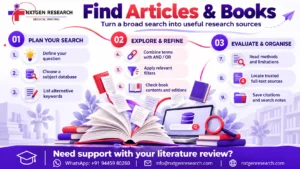
5. Use Filters Wisely
A long list of irrelevant results may tempt you to apply several filters immediately. Before doing so, consider what information you might remove from your search.
A date filter can be useful when researching recent developments in a technology, but it may exclude earlier research that is essential for understanding the topic. Some foundational journal articles remain important even when they were published many years ago.
A peer-review filter may also be necessary, depending on your research requirements. However, journals publish different types of content, including original research, reviews, editorials, and commentaries. If you specifically need peer reviewed articles, check the publication type and review requirements carefully.
Language filters can help you narrow your results, but consider their limitations before excluding publications. Relevant scientific articles may be available in languages other than the one you initially select.
Access should not be your only criterion when deciding which research articles to keep. An article that you cannot open immediately may still be available through another university subscription, an institutional repository, or your library’s document delivery service.
By applying filters thoughtfully, you can narrow your search without overlooking useful evidence.
6. Look Inside Books
A book title that initially seems vague may contain a chapter that directly addresses your research question. Use your library’s subject, author, and title searches to identify relevant books, then examine their contents to locate useful chapters.
If a book includes a table of contents or an index, review these sections before deciding whether the material is worth your time.
Consider the edition as well. Some research topics benefit from the latest edition, while others require an earlier publication to explain how a theory, method, or concept developed.
WorldCat can help you locate libraries that hold a particular book. Your local library may also be able to request a copy through interlibrary loan. Checking your library catalogue is another way to identify available books and related resources.
When using an edited book, record the specific chapters that support your research. Keep track of the chapter author, book title, editor names, publication year, and other relevant details.
Books can complement research articles by providing broader explanations, theoretical background, and historical context. Using both types of resources can help you develop a more complete understanding of your research topic.
7. Read Strategically
A relevant source does not always provide useful information. Keep your research question in mind as you read and ask yourself how each source contributes to answering it.
When evaluating research articles, pay attention to the research question, study design, population, measurements, results, conclusions, limitations, and implications. Consider whether the results support the authors’ claims and whether the study setting affects the relevance of the findings to your own research.
An abstract summarises an article and can help you decide whether it deserves closer attention. However, it rarely provides enough detail to evaluate the full value of a study. Read the methods and results sections when you need to assess how the research was conducted and what the findings actually demonstrate.
For books, identify the central argument and the evidence used to support it. Focus on the chapters that contribute most directly to your topic rather than reading every page without a clear purpose.
If two scientific articles present conflicting findings, compare their methods, populations, study settings, and limitations. Understanding why their conclusions differ can help you assess the strength of the evidence and identify important issues for your literature review.
The goal is not simply to collect as many academic articles as possible. It is to understand what the available evidence shows, where studies agree or disagree, and how those findings relate to your research question.
8. Follow Citations and Access Resources
A useful research article often contains references to other publications that may be relevant to your topic. Examine the reference list to identify earlier studies, related research, and sources that explain the development of an idea.
You can also use citation tracking tools to discover more recent journal articles that have cited a paper you find useful. This can help you follow how a particular research question has developed over time.
However, a paper being cited by another publication does not automatically make it relevant to your research. Evaluate each source individually and consider whether it contributes useful evidence, context, or methodology.
Use your university library’s access tools, the publisher’s website, or other legitimate resources to obtain the full text of an article. PubMed records often include links to publisher websites or PubMed Central, an open-access repository containing eligible biomedical literature.
If you cannot access a paper, ask your librarian for assistance. They may be able to help you locate an accessible version or obtain the publication through an institutional service.
Following citations and exploring related publications can help you discover scientific articles beyond your initial database results. This is particularly useful when conducting a literature review that requires a broader understanding of the existing evidence.
9. Make Notes for Yourself
A folder full of PDFs can quickly become difficult to manage if you cannot remember why you saved each source. When downloading research articles, consider adding a short note explaining why the publication is relevant to your work.
You might record the main finding, the section of your research it supports, and any limitations that could affect how you use the information.
Keep track of your reading in a literature matrix, spreadsheet, reference manager, or another system that suits your workflow. The aim is to organise information so that you can find and understand it easily when writing your research paper.
Save direct quotations separately and include page numbers whenever available. Keep your summaries and notes organised, and record the database name, search date, search terms, and filters you used. This information makes it easier to repeat or update your search later.
For each important journal article, record enough bibliographic information to create an accurate reference. This may include the authors, publication year, article title, journal name, volume, issue, page range, and DOI, where available.
These notes will save time when you return to your research after several days or weeks. They can also help you compare findings across publications and organise evidence for your literature review.
Bringing Your Evidence Back to Your Research Question
As you search for sources, you may find yourself reconsidering how your research question is worded. You might discover useful terminology, identify authors who frequently publish in the field, or realise that your original topic needs to be narrowed.
Keep returning to your research question whenever you evaluate a source. Ask yourself whether the publication helps answer the question, explains an important concept, supports your methodology, or identifies a gap in the existing literature.
A carefully selected collection of research articles and books provides a foundation for your own work. The next step is to connect the findings, compare the evidence, and organise your understanding into a coherent argument.
Need help with your literature review or manuscript? Contact NxtGen Research to discuss your topic, current writing, and deadline to receive literature-search, organisation, and research-writing assistance.
Need support with your literature search or manuscript?
Share your research topic, current draft and deadline with NxtGen Research to discuss literature-search, evidence-organisation and editing support.
WhatsApp: +91 94459 80260
Email: info@nxtgenresearch.com
FAQ
1. How do I choose a database for my discipline?
Start with your university library’s subject guides. Choose a database that covers your research area, such as PubMed for biomedical literature, ERIC for education or IEEE Xplore for engineering. If your topic crosses disciplines, search more than one resource.
2. How can I find peer reviewed articles?
Use a peer-review filter where the database offers one. Then check the journal’s review policy and the type of article you have found. Editorials, letters and news items may follow different review processes from original research papers.
3. What should I do if my search returns too many articles?
Add a term that describes the specific population, issue or setting you are studying. Combine separate concepts with AND and alternative terms with OR. Apply date or subject filters only when they make sense for your question.
4. How can I access research articles behind a paywall?
Check whether your university library provides access. You can also look for a legally available version in an institutional repository or ask your library about interlibrary loan. If necessary, contact the author to ask whether they can share a copy.
5. How do I find books relevant to my research topic?
Search your library catalogue using subject terms, author names and related keywords. Look through the contents page and index, as a useful chapter may appear in a book with a broader title. Check the edition and publication date before choosing a source.
6. What details should I record during a literature search?
Save the database name, search date, search terms and filters used. For each useful source, record its citation, main findings, limitations and relevance to your question. Keep direct quotations separate from your own notes and include page numbers where appropriate.