Introduction
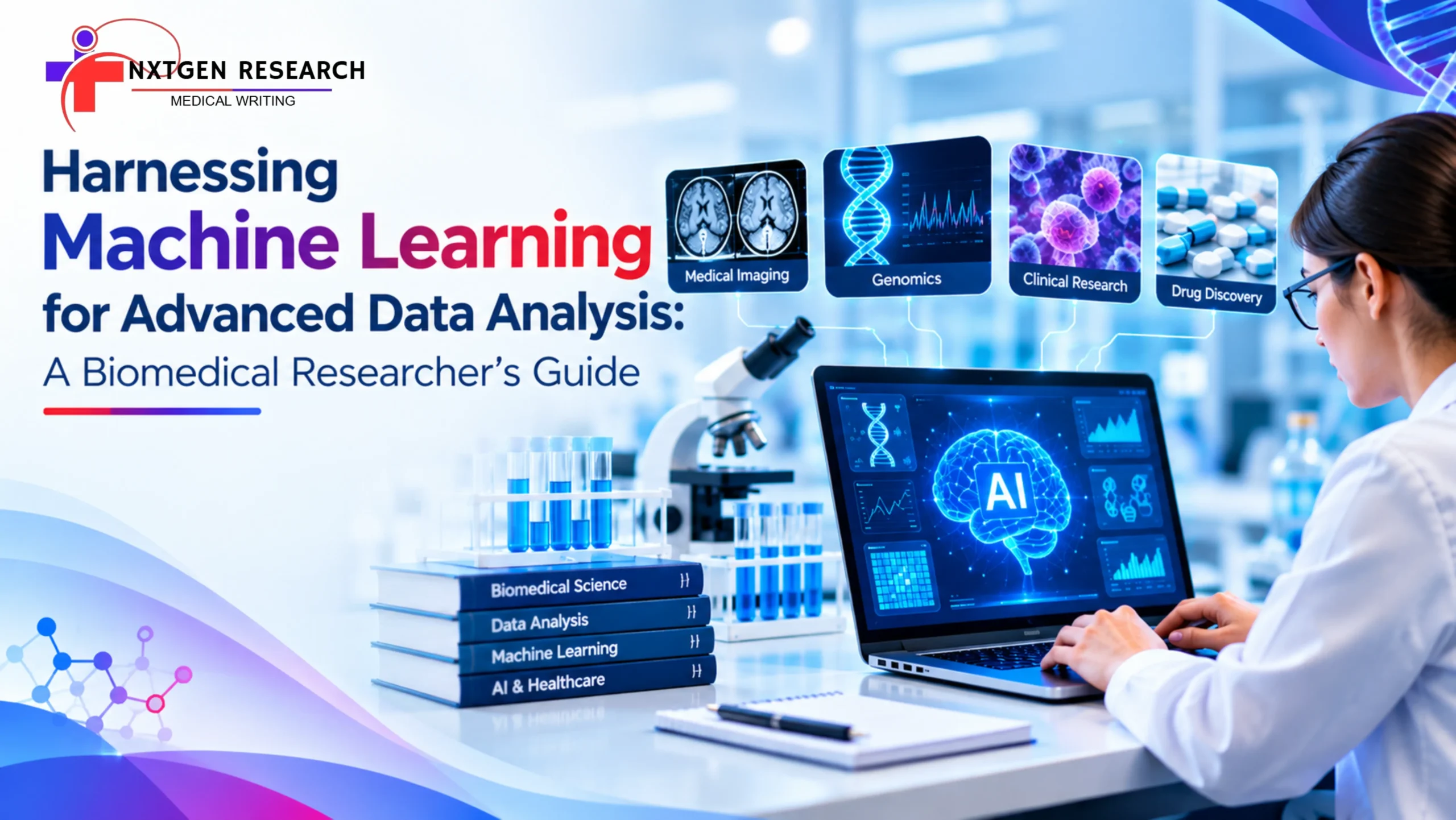
Machine Learning is rapidly changing how biomedical researchers analyse complex datasets, identify patterns, and generate meaningful insights from large volumes of biological and clinical information. From genomic datasets and medical imaging to patient records and drug-development studies, modern biomedical research increasingly depends on advanced data analysis techniques that can handle complex variables and relationships.
For biomedical researchers, understanding how machine learning works—and knowing when it is appropriate to use—can improve the way research questions are explored and data-driven findings are interpreted. Rather than replacing established research methods, machine learning can complement statistical analysis and provide additional approaches for examining complex datasets.
This guide explores the role of machine learning in biomedical science, its major applications, commonly used techniques, benefits, challenges, and practical considerations for researchers.
What Is Machine Learning?
Machine learning is a branch of artificial intelligence that enables computer systems to learn patterns from data and use those patterns to make predictions, classifications, or analytical decisions.
Unlike traditional computer programs that depend entirely on predefined instructions, machine-learning models identify relationships within data during the training process. Once trained, a model can apply the learned patterns to new observations.
In biomedical research, machine learning can support tasks such as:
- Disease classification
- Risk prediction
- Biomarker discovery
- Medical image analysis
- Patient stratification
- Treatment-response prediction
- Clinical outcome prediction
- Biological pattern recognition
The usefulness of a machine-learning model depends on several factors, including data quality, study design, sample size, model selection, validation, and interpretation.
Why Machine Learning Matters in Biomedical Research
Biomedical datasets are often large, high-dimensional, heterogeneous, and difficult to analyse using a single conventional statistical approach.
For example, a research dataset may contain demographic characteristics, laboratory measurements, imaging information, genetic variables, treatment history, and clinical outcomes. These variables may interact with one another in complex ways.
Machine learning can help researchers explore such datasets by identifying non-linear relationships and patterns that may be difficult to detect through traditional analytical approaches.
It can also assist with automated classification and prediction when models are properly developed and validated.
However, machine learning should not automatically replace conventional statistical analysis. In many research projects, both approaches can work together. Statistical methods can help researchers investigate specific hypotheses, while machine-learning methods can be useful for prediction, classification, and pattern discovery.
Applications of Machine Learning in Biomedical Science
1.Medical Imaging
Medical imaging is one of the areas where machine learning and deep learning have attracted considerable research interest.
Machine-learning algorithms can be trained to analyse medical images and identify specific patterns or features. Applications may include:
- Tumour detection and classification
- Cell and tissue segmentation
- Identification of imaging biomarkers
- Image quality assessment
- Disease classification
- Computer-assisted diagnostic research
Deep learning models can process large numbers of images and learn features directly from the data. However, strong performance on a training dataset does not necessarily mean that a model will perform equally well on new patients or datasets.
Independent validation is therefore an important part of biomedical imaging research.
2.Genomics and Bioinformatics
Modern sequencing technologies generate enormous quantities of biological information. Analysing these datasets manually can be challenging because researchers may need to examine thousands or even millions of variables.
Machine learning can support genomic and bioinformatics research by helping identify patterns within molecular datasets.
Potential applications include:
- Gene-expression classification
- Biomarker discovery
- Disease subtype identification
- Genomic pattern recognition
- Prediction of molecular responses
- Analysis of biological relationships
Combining machine learning with bioinformatics can provide researchers with additional tools for exploring complex biological systems and generating hypotheses for further investigation.
3.Clinical and Patient Data
Clinical research datasets can contain valuable information about patient characteristics, laboratory results, diagnoses, treatments, and outcomes.
Machine-learning models can be developed to investigate patterns associated with clinical outcomes and patient risk.
For example, researchers may explore models for predicting:
- Disease progression
- Treatment response
- Hospital readmission
- Adverse outcomes
- Patient risk
- Clinical outcomes
These applications require careful attention to missing data, class imbalance, privacy, dataset bias, and the representativeness of the study population.
4.Drug Discovery and Development
Artificial intelligence and machine learning are increasingly being investigated in drug discovery and development.
Researchers can use computational models to explore molecular properties, identify potential drug candidates, analyse biological targets, and investigate relationships between compounds and biological systems.
These approaches may help researchers prioritise candidates for further investigation and reduce the time required to screen large numbers of possibilities.
However, computational predictions should not be treated as proof of biological or clinical effectiveness. Experimental and clinical validation remains essential.
Machine Learning Methods Biomedical Researchers Should Know
Different research questions require different machine-learning approaches.
Supervised Learning
Supervised learning uses labelled data to train a model to predict an outcome or classify observations.
Common approaches include:
- Logistic regression
- Decision trees
- Random forests
- Support vector machines
- Neural networks
For example, a researcher could train a model using patient characteristics and laboratory measurements to classify individuals according to a predefined disease outcome.
Unsupervised Learning
Unsupervised learning is used when predefined outcome labels are not available.
Researchers can use clustering and dimensionality-reduction techniques to explore patterns and identify groups within a dataset.
This can be useful during exploratory research, particularly when researchers want to investigate whether biological or clinical subgroups exist within a population.
Deep Learning
Deep learning is a specialised area of machine learning based on multi-layer neural networks.
It is particularly useful for complex datasets such as:
- Medical images
- Biological signals
- Genomic information
- Natural-language data
- Large-scale biomedical datasets
Deep learning can be powerful, but it often requires substantial amounts of data, computational resources, and careful validation.
A Practical Workflow for Advanced Data Analysis
A successful machine-learning project begins well before model training.
Step 1: Define the Research Question
Clearly identify the research objective, population, predictors, outcome, and intended use of the model.
A clearly defined research question helps determine whether machine learning is actually appropriate for the project.
Step 2: Prepare the Data
Data preparation may involve:
- Handling missing values
- Removing duplicates
- Checking unusual observations
- Standardising variables
- Correcting inconsistent formats
- Identifying potential data-quality problems
Poor-quality input data can affect model performance regardless of the sophistication of the algorithm.
Step 3: Explore the Dataset
Exploratory data analysis helps researchers understand distributions, relationships, correlations, class imbalance, and unusual observations.
This stage can also reveal potential problems before modelling begins.
Step 4: Select Relevant Features
Researchers may need to select informative variables or apply dimensionality-reduction techniques when working with high-dimensional datasets.
Feature selection should be performed carefully to avoid introducing bias or data leakage.
Step 5: Train the Model
The available data is commonly separated into training and testing components. Cross-validation may also be used during model development to obtain a more reliable estimate of model performance.
Step 6: Evaluate Performance
The appropriate evaluation metrics depend on the research task.
Possible metrics include:
- Accuracy
- Sensitivity
- Specificity
- Precision
- Recall
- F1 score
- Area under the ROC curve
- Mean absolute error
- Root mean squared error
Researchers should select metrics that reflect the actual scientific or clinical objective rather than relying on a single measure.
Step 7: Validate and Interpret
Independent or external validation can provide stronger evidence about whether a model generalises to new datasets.
Researchers should also consider how the model reaches its predictions and whether those predictions can be meaningfully interpreted within the context of the research question.
Benefits of Machine Learning for Biomedical Research
When appropriately applied, machine learning can provide several advantages for advanced data analysis.
Handling Complex Data
Machine learning can work with large and high-dimensional datasets containing numerous variables.
Identifying Complex Patterns
Some algorithms can identify non-linear relationships and interactions that may be difficult to detect using simpler analytical approaches.
Prediction and Classification
Models can support prediction and classification tasks across clinical, biological, and experimental research.
Supporting Biomarker Discovery
Machine-learning approaches can help researchers identify variables or combinations of variables that may warrant further investigation as potential biomarkers.
Integrating Different Data Types
Machine learning can also support the analysis of multiple types of biomedical information, depending on the research design and available data.
Challenges and Limitations
Despite its potential, machine learning introduces several challenges that biomedical researchers need to consider.
Overfitting
A model may perform extremely well on development data but perform poorly when applied to new observations.
Data Leakage
Information from the test dataset can unintentionally influence model development, producing overly optimistic performance estimates.
Small Sample Sizes
Biomedical studies may contain many variables but relatively few participants. This can make model development and validation challenging.
Dataset Bias
If training data does not adequately represent the target population, model performance may not generalise to other groups.
Missing Data
Incomplete clinical or biological datasets can affect model reliability and may require carefully selected strategies for handling missing information.
Interpretability
Some advanced models can be difficult to interpret. Researchers should consider whether the level of model complexity is appropriate for their scientific objective.
Privacy and Data Governance
Biomedical and clinical datasets may contain sensitive information. Researchers must follow applicable ethical, privacy, security, and data-governance requirements.
Combining Machine Learning with Traditional Statistical Analysis
Machine learning and conventional statistics should not necessarily be viewed as competing approaches.
Traditional statistical methods can provide estimates, confidence intervals, hypothesis tests, and interpretable relationships between variables.
Machine-learning methods can provide powerful approaches for prediction, classification, and identifying complex patterns.
A biomedical research project may therefore use statistical analysis to describe a study population and investigate specific hypotheses while using machine learning for prediction or classification.
The appropriate approach depends on the research question, study design, dataset characteristics, and intended outcome.
Best Practices for Biomedical Researchers
Researchers planning to incorporate machine learning into their work should maintain a transparent analytical workflow.
Important practices include:
- Clearly defining the research question
- Understanding the characteristics of the dataset
- Using appropriate preprocessing methods
- Avoiding data leakage
- Separating model development from final evaluation
- Selecting suitable performance metrics
- Using cross-validation where appropriate
- Performing external validation when feasible
- Documenting analytical decisions
- Reporting limitations transparently
- Considering reproducibility and data governance
The most technically sophisticated model is not automatically the most scientifically useful model. Methodological quality and appropriate validation remain central to reliable biomedical research.
Conclusion
Machine learning is becoming an increasingly important component of advanced data analysis in biomedical science. Its applications extend across medical imaging, genomics, clinical research, drug discovery, and many other fields where researchers need to work with complex datasets.
For biomedical researchers, the goal should not simply be to use artificial intelligence and machine learning because the technology is available. Instead, machine learning should be selected when it addresses a clearly defined research problem and can be supported by high-quality data, appropriate methodology, rigorous validation, and transparent reporting.
When these principles are followed, machine learning can complement conventional research methods and help biomedical scientists extract meaningful insights from increasingly complex datasets.
NxtGen Research supports researchers in navigating modern research methodologies, advanced data analysis, and evidence-based scientific workflows.
FAQ
What is machine learning in biomedical research?
Machine learning is an artificial intelligence approach that allows computational models to learn patterns from biomedical data and use those patterns for tasks such as classification, prediction, and pattern discovery.
How is machine learning used in biomedical science?
It can be used in medical imaging, genomics, bioinformatics, clinical research, biomarker discovery, patient stratification, drug discovery, and other areas involving complex datasets.
Is machine learning better than traditional statistical analysis?
Machine learning and traditional statistical analysis serve different purposes. In many biomedical research projects, they can complement one another rather than one completely replacing the other.
What is the role of deep learning in biomedical research?
Deep learning can analyse complex datasets such as medical images, biological signals, genomic information, and other high-dimensional data. Its suitability depends on the research question, dataset, and validation requirements.
Why is validation important in machine-learning research?
Validation helps determine whether a model performs reliably on data that were not used to develop the model. External validation can provide additional evidence about generalisability.
How can researchers ensure the quality of a machine-learning model?
Researchers can improve model quality by using high-quality data, appropriate preprocessing, cross-validation, suitable performance metrics, independent or external validation, and transparent reporting of the model-development process.