Introduction
Understanding Complex Biology Through Data Modern medical research generates enormous amounts of biological data, from DNA sequences and RNA expression profiles to proteins and metabolites. Understanding this information requires more than laboratory experimentation alone. Researchers need computational methods to organize, analyze, and interpret molecular data, enabling them to investigate biological processes and disease mechanisms more effectively.
Bioinformatics connects biology, computer science, statistics, and data analysis to transform complex biological datasets into meaningful research insights. When combined with genomics, transcriptomics, and other omics technologies, bioinformatics supports the investigation of molecular pathways, genetic variation, and cellular functions.
As research questions become increasingly complex, bioinformatics and genomics expertise can help researchers integrate different types of biological evidence. This approach supports scientific discovery, hypothesis generation, and the development of research strategies for studying human health and disease.
What Is Bioinformatics and Why Does It Matter? Bioinformatics is an interdisciplinary field that uses computational tools, algorithms, databases, and statistical approaches to analyze biological information. It is particularly important in modern research because sequencing technologies and high-throughput experiments produce datasets that are too large and complex to interpret manually.
In medical research, bioinformatics can be used to process genomic sequences, identify genetic variants, analyze gene expression, and explore relationships between molecular changes and disease-related characteristics.
A typical bioinformatics workflow may include:
- Biological data collection and organization
- Quality control and preprocessing
- Sequence alignment and computational analysis
- Statistical testing and interpretation
- Visualization and reporting of research findings
The precise workflow depends on the research question, sample type, experimental design, and data platform. Proper analytical methods are essential for reducing technical errors and improving the reliability of conclusions.
Connecting Bioinformatics with Genomics and Omics Technologies Genomics focuses on studying an organism’s genetic material, including genome structure, sequence variation, and functional elements. It can help researchers investigate inherited variants, mutations, and genetic factors associated with biological traits or disease.
Bioinformatics provides computational support for genomic analysis by helping researchers process sequencing data, compare sequences, annotate genomic regions, and investigate potentially important variants.
However, DNA alone does not describe every aspect of biological activity. Researchers may also need to study RNA, proteins, metabolites, and other molecular components. This is where omics technologies become valuable.
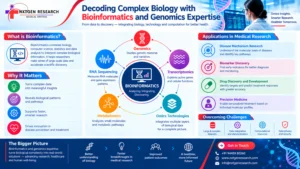
Major omics fields include:
Genomics: Investigation of genetic material and genome-wide variation.
Transcriptomics: Study of RNA transcripts and gene expression.
Proteomics: Analysis of proteins and their abundance or functional characteristics.
Metabolomics: Investigation of small-molecule metabolites in biological systems.
Each approach provides a different perspective on biology. Integrating multiple datasets may help researchers examine relationships between genetic information, gene regulation, protein activity, and metabolic processes.
Multi-omics research can therefore provide a broader view of biological systems than an isolated molecular measurement. Nevertheless, integration requires appropriate experimental design, statistical methods, data quality assessment, and biological interpretation.
The Role of Transcriptomics and RNA Sequencing Transcriptomics investigates the RNA molecules produced by cells or tissues under specific biological conditions. Because gene expression can change in response to development, environmental factors, disease, or treatment, transcriptomic analysis is widely used to explore cellular activity.
RNA sequencing (RNA sequencing or RNA-seq) is a high-throughput method used to detect and quantify RNA molecules in a sample. It can support the analysis of gene expression, transcript diversity, and alternative splicing.
Bioinformatics is essential throughout the RNA-seq workflow. Depending on the study design, the process may involve:
- Assessing sequencing quality and preparing raw data.
- Aligning reads to a reference genome or using transcriptome-based approaches.
- Quantifying transcripts or gene expression.
- Performing differential expression analysis.
- Investigating biological pathways and functional relationships.
For example, researchers studying a disease-related tissue may compare gene expression profiles between affected and control samples. Computational analysis can identify genes with differences in expression, which may then be investigated through additional laboratory experiments.
It is important to recognize that a statistically significant expression difference does not automatically establish a causal disease mechanism. Experimental validation and appropriate biological context remain necessary.
Understanding Metabolomics in Medical Research Metabolomics focuses on the comprehensive study of small molecules, including metabolic intermediates and other metabolites present in biological samples. These molecules can reflect biochemical activity and changes associated with physiological or pathological conditions.
Metabolomics commonly uses analytical platforms such as mass spectrometry and nuclear magnetic resonance spectroscopy. Bioinformatics and statistical analysis help researchers process metabolite measurements, identify patterns, and explore relationships with biological or clinical characteristics.
For example, a study may investigate differences in metabolite profiles between patient groups to identify metabolic pathways associated with a particular condition. Researchers can use computational approaches to assess data quality, normalize measurements where appropriate, and perform pathway-based interpretation.
Combining metabolomics with genomics or transcriptomics may help investigate how genetic and gene-expression changes relate to downstream metabolic activity. However, such relationships require careful interpretation because metabolic profiles can be influenced by diet, medication, environment, sample handling, and other factors.
Applications of Bioinformatics in Medical Research Bioinformatics has applications across several areas of biomedical and life science research. Its value depends on the study objectives, data quality, and analytical methods used.
- Disease Mechanism Research Researchers can use genomic and transcriptomic data to investigate molecular pathways associated with diseases. By studying genetic variation and gene expression, researchers may generate hypotheses about biological processes involved in disease development or progression.
- Biomarker Discovery Bioinformatics can support the identification of candidate biomarkers by analyzing molecular patterns associated with a disease or clinical characteristic. Candidate findings require validation in independent datasets and, where relevant, experimental or clinical studies before clinical use can be established.
- Drug Discovery and Development Computational analysis of genomic, transcriptomic, and metabolomic data can help researchers investigate potential drug targets, biological pathways, and molecular responses to treatment. These analyses may support early-stage research, although computational findings alone do not demonstrate drug efficacy or safety.
- Precision Medicine Research Integrating molecular information with relevant clinical characteristics may help researchers investigate differences between individuals and patient groups. Genomics, transcriptomics, and metabolomics can contribute to research exploring treatment response and disease stratification.
The translation of research findings into clinical applications requires rigorous validation, reproducibility, and appropriate regulatory and clinical evaluation.
Challenges in Bioinformatics and Multi-Omics Research Although bioinformatics offers valuable opportunities, analyzing complex biological data presents several challenges.
Data quality and preprocessing: Sequencing and molecular datasets may contain technical variation, incomplete measurements, or other sources of error. Quality control and appropriate preprocessing are essential.
Statistical complexity:
High-dimensional datasets can increase the risk of false-positive findings, overfitting, and misleading associations. Researchers must select suitable statistical methods and account for study design.
Data integration:
Combining genomics, transcriptomics, and metabolomics data can be challenging because different platforms have distinct measurement characteristics, scales, and sources of variation.
Reproducibility:
Documented workflows, transparent analytical decisions, appropriate metadata, and independent validation can improve confidence in research findings.
Addressing these challenges requires collaboration between domain experts, computational researchers, statisticians, and laboratory scientists.
Conclusion:
Advancing Biological Discovery Through Expertise Bioinformatics plays an important role in modern medical research by helping scientists analyze and interpret complex biological datasets. When combined with genomics, transcriptomics, RNA sequencing, metabolomics, and other omics technologies, it supports a more integrated understanding of biological systems.
From disease mechanism research and candidate biomarker discovery to drug development and precision medicine studies, computational analysis can help researchers generate meaningful hypotheses and identify opportunities for further investigation.
However, reliable scientific conclusions depend on sound experimental design, high-quality data, appropriate statistical methods, and biological validation. Integrating computational expertise with laboratory and clinical knowledge can strengthen research workflows and contribute to evidence-based advances in biomedical science.
As biological datasets continue to expand, bioinformatics and genomics expertise will remain important for researchers seeking to decode complex biology and develop scientifically robust research outcomes.
FAQs
1.What is bioinformatics in medical research?
Bioinformatics is the use of computational methods, algorithms, and statistical techniques to analyze biological data. In medical research, it supports the study of genomic sequences, gene expression, molecular pathways, and disease-related biological patterns.
2.How are genomics and bioinformatics connected?
Genomics studies an organism’s genetic material, while bioinformatics provides computational methods for processing and interpreting genomic data. Together, they help researchers investigate genetic variation, genome structure, and biological functions.
3.What is the role of RNA sequencing in transcriptomics?
RNA sequencing measures RNA molecules in biological samples and can be used to study gene expression, transcript diversity, and alternative splicing. Bioinformatics helps process and interpret RNA-seq datasets.
4.Why are omics technologies important in medical research?
Omics technologies allow researchers to investigate biological information at different molecular levels, including DNA, RNA, proteins, and metabolites. Integrating these data types may provide broader insights into biological processes and disease mechanisms.
5.How does metabolomics support bioinformatics research?
Metabolomics generates data about small molecules in biological samples. Bioinformatics and statistical approaches help researchers process metabolite measurements, identify patterns, and explore biochemical pathways.
6.Can bioinformatics findings be used directly for clinical diagnosis?
Bioinformatics findings may contribute to clinical research and the development of potential diagnostic approaches. However, clinical use requires appropriate validation, evidence, and regulatory evaluation. Computational results alone are not sufficient to establish a diagnostic test.