Introduction
AI can write a paragraph in seconds. But can it tell you whether that paragraph belongs in a publishable research paper?
That question matters because modern researchers are using AI tools throughout the writing process. From improving grammar and restructuring sentences to organizing ideas and summarizing information, technology can make scientific writing faster.
For researchers working under deadlines, this support can be useful. It can also help authors who find it difficult to communicate complex research in English.
Yet good language is only one part of a successful manuscript. Publication readiness depends on the quality of the research question, methodology, statistical analysis, interpretation, evidence, ethical standards, and journal selection.
In other words, publication readiness is not simply about making a paper sound professional. It is about making sure the research can stand up to editorial and peer review.
1.AI Is Changing Scientific Writing
Scientific writing involves many repetitive tasks. Researchers spend considerable time correcting grammar, improving transitions, shortening sentences, removing repetition, and restructuring paragraphs.
AI-assisted writing can help with some of this work. Researchers can use it to:
- Improve grammar and sentence structure
- Simplify complicated sentences
- Organize ideas
- Identify repeated information
- Improve abstracts and summaries
- Suggest clearer wording
- Create an initial outline
Used responsibly, AI-assisted writing can reduce the mechanical workload involved in preparing a manuscript.
However, better wording does not necessarily mean better research. An AI tool may produce a convincing explanation without understanding the study design, the limitations of the data, or the reason a particular statistical method was selected.
That is why publication readiness requires more than language editing.
2.What Publication Readiness Really Means
Publication readiness refers to the point at which a research paper has been reviewed carefully enough to be considered suitable for submission.
It covers both scientific quality and publishing requirements. A manuscript should communicate its research question clearly, explain the methodology adequately, present results accurately, and interpret findings within the limits of the evidence.
It should also meet relevant ethical, reporting, formatting, and journal-specific requirements.
Good publication readiness therefore involves looking at the entire manuscript rather than focusing only on individual sentences.
3.Start With the Research Question
Every strong study begins with a clear research question.
Readers should quickly understand what the researchers investigated, why the topic matters, and what gap the study attempts to address.
The introduction, objectives, hypotheses, methods, results, and conclusion should connect logically.
If the research question is unclear, changing the wording will not fix the underlying problem. Publication readiness begins with making sure the study has a clear purpose and that the manuscript communicates that purpose consistently.
4.Research Methodology Must Match the Objective
A well-presented paper can still have weaknesses if the research methodology does not support the research objective.
Study design, participant selection, inclusion and exclusion criteria, data collection, outcome measures, and other procedures should be appropriate for the question being investigated.
During manuscript review, researchers should ask whether the methods are described clearly and whether another researcher could understand how the study was conducted.
Publication readiness depends partly on this methodological consistency. The methods should support the results, and the results should support the conclusions.
5.Statistical Analysis Needs Careful Review
Statistical analysis should never be included simply because it makes a manuscript appear more technical.
Researchers need to consider whether the selected tests are appropriate for the study design, variables, sample size, data characteristics, and research objectives.
The numerical results should also agree across the text, tables, and figures.
AI-assisted writing may help explain statistical terminology, but researchers remain responsible for checking the calculations and interpretation.
Publication readiness requires the statistical analysis to be accurate, transparent, and connected to the research question.
6.Interpret Findings Without Overstating Them
A research paper should distinguish between what the data demonstrate and what the authors believe the findings may suggest.
For example, an observational study may identify an association without establishing causation. A statistically significant result may also have limited practical importance.
The discussion should explain the findings, compare them with existing evidence, and acknowledge relevant limitations.
This is particularly important in medical writing, where inaccurate interpretation can affect how research findings are understood by professionals and the wider public.
Publication readiness requires careful scientific judgment at this stage.
7.References Should Support the Story
Scientific publishing depends on reliable evidence.
References should genuinely support the claims made in the manuscript. Authors should check important citations against the original publications rather than relying entirely on automated tools.
AI-assisted writing can help organize information, but it should not be trusted to verify every reference or factual statement.
During manuscript preparation, researchers should examine whether important claims have appropriate and current evidence behind them.
A strong reference base contributes directly to publication readiness because reviewers often examine whether the discussion is supported by relevant literature.
8.Ethics and Reporting Requirements Matter
Scientific publishing involves more than presenting results.
Depending on the study, authors may need to report ethics approval, informed consent, conflicts of interest, authorship information, data availability, funding, and relevant reporting guidelines.
Medical writing may also require particular care when discussing patient information, clinical findings, or healthcare interventions.
These details should be reviewed before submission rather than added at the last minute.
Publication readiness includes checking that the manuscript meets the ethical and reporting expectations relevant to the study and journal.
9.The Human Skills Behind Publication Readiness
AI can assist with language, but researchers still need critical thinking, subject knowledge, and scientific judgment.
Authors must decide whether evidence supports a claim, whether limitations are adequately explained, and whether the conclusions are reasonable.
These decisions cannot be based only on how polished the writing appears.
Good research writing reflects an understanding of the study and its context. AI-assisted writing should support that understanding rather than replace it.
A careful manuscript review can identify weaknesses that automated language tools may overlook.
10.Building a Better Publishing Workflow
A practical workflow can place AI where it provides the most value:
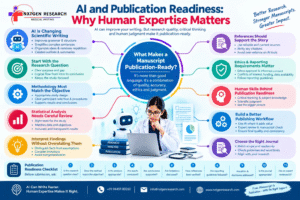
Research → Analysis → Interpretation → Drafting → AI-assisted writing → Expert review → Manuscript review → Publication readiness check → Journal submission
The research team remains responsible for the study, results, and conclusions.
AI can help improve language after the core content has been developed. Expert review can then examine research methodology, statistical analysis, interpretation, reporting, references, and consistency.
This approach allows researchers to benefit from technology while maintaining the standards expected in scientific publishing.
11.Publication Readiness Checklist
Before journal submission, ask:
- Is the research question clearly defined?
- Does the research methodology match the study objective?
- Is the statistical analysis appropriate?
- Are results consistent across the text, tables, and figures?
- Are the conclusions supported by the findings?
- Are limitations discussed honestly?
- Have important references been verified?
- Are relevant reporting guidelines followed?
- Are ethical and disclosure requirements addressed?
- Is the target journal appropriate?
- Has an experienced reviewer examined the manuscript?
If several answers are uncertain, the manuscript may need additional work before journal submission.
12.Choosing the Right Journal
Journal selection can influence the outcome of a submission.
Researchers should consider the journal’s scope, readership, article type, methodology requirements, reporting guidelines, word limits, formatting, and publication policies.
A scientifically sound paper can still struggle when it is sent to an unsuitable journal.
Scientific publishing is not only about producing good research; it is also about presenting that research to the right audience.
Publication readiness should therefore include a careful assessment of journal fit before journal submission.
13.Using AI Responsibly
AI-assisted writing can be useful when researchers understand its limitations.
It may help with language editing, restructuring, outlining, and identifying unclear passages. However, authors should independently verify facts, references, calculations, and scientific claims.
Researchers should also review the AI policies of their target journal. Some publishers require disclosure of AI use, while others may have specific restrictions.
Responsible use of AI supports publication readiness because it keeps researchers involved in every important scientific decision.
14.The Future of Scientific Publishing
AI is likely to become an increasingly common part of scientific publishing.
Researchers may use technology for drafting, editing, information organization, literature-related tasks, and research communication.
At the same time, the importance of critical evaluation will increase.
Researchers who understand both the strengths and limitations of AI will be better prepared to use these tools responsibly.
The goal is not to remove human expertise from research writing. It is to reduce unnecessary writing effort so researchers can spend more time evaluating evidence and improving their work.
15.Final Manuscript Review
Before submission, the entire research manuscript should be read as one connected piece of work.
The title and abstract should accurately reflect the study. The introduction should establish the research problem. The methodology should explain how the work was conducted. The statistical analysis should match the study design. Results should be presented clearly, and the discussion should remain within the limits of the evidence.
This final manuscript review can reveal inconsistencies that are easy to miss when sections are edited separately.
Publication readiness is strongest when the complete paper tells a clear, accurate, and consistent research story.
Conclusion
AI has changed the way researchers approach scientific writing. It can improve language, reduce repetitive work, and make manuscript preparation more efficient. However, publication readiness remains a broader responsibility.
A strong paper needs a clear research question, suitable methodology, reliable statistical analysis, accurate evidence, careful interpretation, ethical awareness, and a suitable journal. AI-assisted writing can support these tasks, but it cannot replace scientific judgment. Good scientific publishing will continue to depend on researchers who understand their evidence and take responsibility for what they publish.
Publication readiness is ultimately about confidence in the complete manuscript: not because it sounds polished, but because the research, evidence, analysis, and conclusions have been carefully examined.
AI can close the writing gap. Human expertise makes the work ready for publication.
FAQs
1. What does publication readiness mean in research?
Publication readiness means ensuring that a research manuscript is scientifically accurate, clearly written, properly structured, ethically compliant, and suitable for submission to the selected journal.
2. Can AI improve scientific writing?
Yes. AI can assist with grammar, sentence structure, organization, clarity, and reducing repetition. However, researchers should review the final content to ensure that the scientific meaning and evidence remain accurate.
3. How can AI-assisted writing help researchers?
AI-assisted writing can reduce the time spent on routine editing tasks. It can help researchers improve language, restructure paragraphs, create outlines, and identify unclear or repetitive sections.
4. Why is publication readiness important before journal submission?
Publication readiness helps identify problems before editors and reviewers see the manuscript. Reviewing methodology, statistical analysis, references, interpretation, ethics, and journal requirements can reduce avoidable issues during submission.
5. What should researchers check before submitting a manuscript?
Researchers should check the research question, methodology, statistical analysis, results, references, limitations, ethical requirements, reporting guidelines, formatting, and suitability of the target journal.
6. Can AI replace researchers in scientific publishing?
No. AI can support writing and editing, but researchers remain responsible for the accuracy, interpretation, originality, and integrity of their work. Scientific publishing still requires human expertise and critical judgment.