
Writing a strong research proposal is an important part of starting a healthcare dissertation or research project. A proposal allows researchers to explain what they want to study, why the topic matters, and how the research will be conducted.
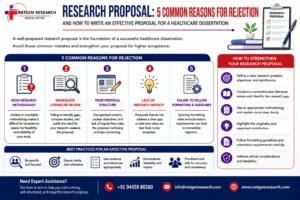
However, many proposals are rejected because they lack a clear research methodology, have a weak literature review, fail to demonstrate originality, or do not follow the required formatting guidelines. In some cases, the research idea may be valuable, but poor presentation and insufficient methodological detail can make it difficult for reviewers to assess the project.
This article discusses five common reasons why a research proposal may be rejected and explains how researchers can strengthen their proposals before submission.
1.Weak Research Methodology
One of the most common reasons for rejecting a research proposal is an unclear or unsuitable research methodology. A healthcare research project needs a clear explanation of how the study will answer its research questions.
The proposal should explain the research design, study population, data collection methods, variables, outcomes, and proposed approach to data analysis. Researchers should also demonstrate why the selected methodology is appropriate for the research problem.
For example, a proposal investigating a healthcare intervention should clearly describe the population being studied, the intervention or exposure, the outcomes being measured, and the methods that will be used to evaluate the results.
A well-developed methodology gives reviewers confidence that the proposed study can be conducted systematically and that the findings will be meaningful.
Professional research proposal writing support can help researchers identify gaps in methodology and improve the overall structure of their proposals. However, the methodology must ultimately reflect the actual research question and study design.
2.Inadequate Literature Review
A literature review is more than a collection of previously published studies. It should demonstrate an understanding of what is already known about the research topic and identify where further investigation is needed.
A weak literature review may simply summarise individual studies without comparing their findings or identifying limitations. This can make it difficult for reviewers to understand the purpose of the proposed research.
A strong review should:
- Introduce the current state of knowledge
- Compare relevant research findings
- Identify limitations or unanswered questions
- Highlight gaps in existing evidence
- Explain how the proposed research addresses those gaps
For a healthcare dissertation, the literature should also be relevant to the specific research question and supported by appropriate academic sources.
Careful literature review writing can help researchers build a stronger foundation for their research proposal and demonstrate why the proposed study is necessary.
3.Poor Proposal Structure and Presentation
Even a promising research idea can become difficult to evaluate when the proposal is poorly organised.
A research proposal should follow a logical structure. The research problem should lead naturally to the research aim, objectives, methodology, and expected outcomes. Reviewers should be able to understand the proposed study without having to search through unrelated information.
A typical healthcare research proposal may include:
- Background and introduction
- Research problem
- Research aim and objectives
- Research questions or hypotheses
- Literature review
- Research methodology
- Ethical considerations
- Data collection and analysis
- Expected outcomes
- References
Researchers should also avoid unnecessary repetition and ensure that each section contributes to the overall research argument.
Professional research writing support can help improve clarity and organisation, while dissertation formatting can ensure that the document follows the requirements of the university or institution.
4.Lack of Research Novelty
Another major reason for rejection is the absence of a clear contribution to existing knowledge.
A research proposal does not necessarily need to introduce a completely new subject. However, it should explain what makes the proposed study worthwhile. The research may address an existing gap, investigate a population that has received limited attention, evaluate an intervention in a different setting, or apply an established method to a new research question.
For example, a healthcare study may examine an existing treatment in a population that has not been adequately represented in previous research. The topic itself may not be entirely new, but the research question and context can still provide a useful contribution.
Researchers should therefore explain the gap in the existing literature and clearly connect that gap to their proposed study.
Editing and academic writing support can help researchers communicate the originality of their ideas more clearly without overstating the significance of the research.
5. Failure to Follow Formatting and Submission Requirements
Formatting may appear less important than the research methodology, but failure to follow submission requirements can create unnecessary problems.
Universities, research institutions, funding bodies, and journals may have specific requirements for proposals. These can include page limits, referencing styles, heading structures, font requirements, research ethics information, and required sections.
A proposal that ignores these instructions may be viewed as incomplete or poorly prepared, even when the underlying research idea is strong.
Before submitting a research proposal, researchers should carefully check the relevant guidelines and confirm that all required sections and supporting documents have been included.
A final formatting and proofreading review can help identify missing information, inconsistent references, structural problems, and presentation errors.
6.How Research Writing Services Can Strengthen a Proposal
Professional research writing support can be useful when researchers need help improving the structure, clarity, and presentation of their proposals.
For healthcare research, particular attention should be given to the research question, methodology, literature review, expected outcomes, and ethical considerations.
For example, a proposal involving a cardiovascular intervention should clearly define its target population, intervention, outcome measures, and proposed analysis. The methodology should also be sufficiently detailed for reviewers to understand how the study will be conducted.
Writing support should complement the researcher’s own ideas rather than replace them. The researcher remains responsible for the accuracy, originality, and academic integrity of the proposal.
7.The Role of Editing in Research Proposal Development
Editing is another important stage before submitting a proposal.
A well-edited document should communicate the research idea clearly and avoid unnecessary repetition. Sentence structure, terminology, references, headings, and transitions between sections should be reviewed carefully.
In healthcare research, technical terminology also needs to be used consistently. Claims should be supported by appropriate evidence, and the proposal should avoid making conclusions that cannot be supported by the available literature.
A detailed editorial review can therefore help researchers present their research ideas more clearly and professionally.
8.Best Practices for an Effective Healthcare Research Proposal
Researchers can improve their proposals by following a few practical principles.
First, the research problem should be clearly defined. The proposal should then explain why the problem deserves investigation and how the proposed study will address it.
The research objectives should be specific and connected to the methodology. The literature review should establish the current evidence and identify the research gap.
Researchers should also consider feasibility. A proposal may be academically interesting but difficult to complete because of limited access to participants, insufficient data, time constraints, or ethical considerations.
A realistic research plan demonstrates that the proposed project can be completed within the available resources and timeframe.
9.Future Developments in Healthcare Research
Healthcare research continues to develop alongside advances in technology, data science, artificial intelligence, and research methodology.
Researchers are increasingly exploring areas such as real-time health data, adaptive study designs, digital healthcare, and AI-assisted analysis. These developments may create new opportunities for healthcare research, but they also introduce questions about data quality, reproducibility, privacy, and research ethics.
Future research proposals will therefore need to balance innovation with methodological rigour and responsible research practices.
Researchers should avoid including emerging technologies simply because they are popular. Instead, any technology or analytical approach should have a clear connection to the research question and study objectives.
10.Strengthening a Research Proposal Before Submission
Before submitting a healthcare research proposal, researchers should review the entire document from the perspective of a potential evaluator.
Ask the following questions:
- Is the research problem clearly explained?
- Are the research objectives specific?
- Does the literature review identify a genuine gap?
- Is the proposed methodology appropriate?
- Can the study realistically be completed?
- Are ethical considerations addressed?
- Is the expected contribution clearly explained?
- Does the proposal follow the required formatting guidelines?
- Are references accurate and consistent?
Answering these questions can help researchers identify weaknesses before the proposal reaches the review stage.
A combination of careful planning, appropriate research methodology, strong literature review, clear writing, and accurate formatting can significantly improve the quality of a healthcare research proposal.
Conclusion
A research proposal can be rejected for several reasons, including weak methodology, an inadequate literature review, poor structure, limited research novelty, and failure to follow formatting or submission requirements.
The quality of the research idea is important, but researchers must also explain that idea clearly and demonstrate how the proposed study will be conducted. A strong proposal should establish a clear research problem, support its rationale with relevant literature, present an appropriate methodology, and explain the potential contribution of the research.
By reviewing these areas carefully before submission, healthcare researchers can develop proposals that are clearer, more structured, feasible, and academically appropriate.
The Ultimate Guide to Crafting a Winning Research Proposal: Tips and Strategies
Understanding the Basics of a Research Proposal
research proposal definition, purpose of research proposal, components of research proposal, research objectives, proposal structure
Key Elements to Include in Your Research Proposal
literature review, research questions, methodology, hypothesis, data collection, analysis plan, timeline, budget
Common Mistakes to Avoid When Writing a Research Proposal
lack of clarity, unrealistic goals, insufficient background, poor methodology description, ignoring guidelines
How to Make Your Research Proposal Stand Out to Reviewers
clear problem statement, strong justification, feasibility, originality, alignment with funding priorities, persuasive language
Tools and Resources to Help You Write an Effective Research Proposal
proposal templates, writing software, citation tools, peer review, academic writing guides
Conclusion: Take Action Now to Develop a Research Proposal That Opens Doors to Funding and Academic Success
FAQs
What do research committees look for in a healthcare research proposal?
Research committees generally assess the clarity of the research problem, objectives, methodology, literature review, feasibility, ethical considerations, and potential contribution of the proposed study.
How do you write a research proposal for a healthcare dissertation?
Start by defining the research problem and objectives, review the existing literature, identify a research gap, select an appropriate methodology, address ethical considerations, and explain the expected outcomes.
Why are healthcare research proposals rejected?
Common reasons include weak methodology, an inadequate literature review, poor proposal structure, limited research novelty, and failure to follow formatting or submission requirements.
How important is methodology in a research proposal?
Methodology is essential because it explains how the research will answer the research questions. A clear and appropriate methodology also helps demonstrate that the proposed study is feasible and can be conducted systematically.
What are the common mistakes in healthcare research proposal writing?
Common mistakes include unclear research objectives, weak literature reviews, unsuitable methodology, insufficient explanation of research novelty, poor organisation, and failure to follow submission guidelines.
How can I improve my research proposal before submission?
Review the research problem, objectives, literature gap, methodology, feasibility, ethical considerations, expected contribution, formatting requirements, and references before submitting the proposal.