
1.Importance of Biostatistics in Clinical Research
Biostatistics plays an important role in clinical research by helping researchers design studies, determine appropriate sample sizes, select relevant endpoints, and choose suitable statistical methods. A well-planned statistical approach helps researchers answer their research questions more reliably.
For example, oncology trials may use hazard ratios and Kaplan–Meier survival analysis to evaluate treatment effects and time-to-event outcomes. The choice of statistical method depends on the research question, study design, type of data, and outcome being measured.
Biostatisticians work closely with researchers to develop appropriate methodologies and statistical analysis plans. NxtGen supports scholars in preparing manuscripts with clear statistical reporting that meets the expectations of scientific journals.
A structured approach to statistical analysis can improve the clarity, reliability, and credibility of research findings and help researchers communicate their results effectively.
2.Responsibilities in Clinical Trial Services
Biostatisticians have an important role throughout the clinical trial process. Their responsibilities can begin during protocol development and continue through sample-size calculation, statistical analysis, interpretation, and preparation of the final research report.
During a clinical trial, they may contribute to randomization, interim analysis, subgroup analysis, handling of missing data, and the development of the statistical analysis plan. They also help researchers determine how primary and secondary outcomes should be analyzed.
For example, cardiology trials may examine outcomes such as mortality, hospitalization, or other clinically relevant endpoints. Appropriate statistical methods help researchers interpret these outcomes without overstating the findings.
NxtGen helps researchers refine their manuscripts and present statistical findings in a clear and organized manner, supporting better communication between researchers, reviewers, and scientific audiences.
3.Biostatistics and Scientific Research Publications
Clear statistical reporting is an essential part of scientific research publication. Research manuscripts should explain how participants were selected, how data were analyzed, which statistical methods were used, and how the results should be interpreted.
Depending on the study design, researchers may report confidence intervals, effect estimates, statistical tests, subgroup analyses, or other relevant measures. For example, diabetes studies may report changes in HbA1c alongside safety outcomes and other clinically meaningful measures.
Biostatisticians help ensure that the statistical methods correspond with the research question and study design. Appropriate statistical reporting also makes it easier for readers to understand and assess the findings.
NxtGen provides manuscript support to help researchers present statistical methods and findings clearly while maintaining consistency with scientific publication requirements.
4.Role in Evidence-Based Medicine
Biostatistics is closely connected with evidence-based medicine because it provides the methods needed to interpret research findings and assess the strength of available evidence.
Clinical researchers often work with data from clinical trials, observational studies, systematic reviews, and meta-analyses. Statistical methods help researchers compare outcomes, estimate effects, identify patterns, and understand uncertainty in the results.
For example, oncology research may examine progression-free survival, overall survival, treatment response, or biomarker-related outcomes. Statistical analysis helps researchers determine how these findings should be interpreted in the context of the research question.
NxtGen assists researchers in refining research manuscripts and presenting findings in a structured way. This can help make clinical evidence easier to understand and apply in evidence-based medical practice.
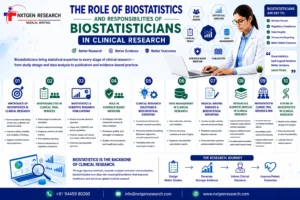
5.Clinical Research Solutions and Biostatistical Expertise
Every clinical research project has its own objectives, population, study design, and data requirements. Biostatisticians therefore need to select statistical approaches that are appropriate for the specific research question rather than applying the same method to every study.
Their contribution may include study design, sample-size calculation, selection of endpoints, statistical modeling, data interpretation, and preparation of analysis plans.
For example, Bayesian methods may be appropriate for some clinical research questions where prior information can be incorporated into the statistical model. Other studies may require regression analysis, survival analysis, longitudinal methods, or other approaches depending on the data.
NxtGen provides support in research writing and manuscript preparation, helping researchers communicate complex statistical findings in a clear and organized manner.
6.Data Management in Clinical Research
Reliable data are essential for producing meaningful findings. Clinical research therefore requires careful attention to data collection, data cleaning, data validation, and statistical analysis.
Biostatisticians work with research teams to understand the structure and quality of the dataset before performing statistical analyses. They may also contribute to defining analysis populations, identifying missing information, checking data consistency, and determining how specific data issues should be handled.
For example, cardiovascular studies may collect information on mortality, hospitalization, treatment response, and other patient outcomes. The quality of these data directly affects the reliability of the statistical results.
NxtGen helps researchers improve the presentation of statistical methods and findings in research manuscripts, with an emphasis on clarity, reproducibility, and transparent reporting.
7.Medical Writing Services and Biostatistical Reporting
Statistical findings can be difficult to communicate when they involve complex models or large datasets. Medical writing plays an important role in translating these findings into clear sections that readers can understand.
Biostatisticians and medical writers can work together to present statistical methods, results, tables, figures, and interpretations accurately.
For example, oncology research may report hazard ratios, confidence intervals, survival estimates, and subgroup analyses. These results need to be explained carefully so that readers understand both the statistical findings and their clinical relevance.
NxtGen supports researchers with medical writing and manuscript refinement, helping them organize statistical information into clear and publication-ready sections.
8.Research Articles and Scientific Articles in Clinical Research
Research articles should provide enough statistical information for readers to understand how the findings were obtained. This includes describing the study population, outcomes, statistical methods, and key results.
Biostatisticians can help ensure that the analysis is appropriate for the study design and that the reported results accurately reflect the underlying data.
For example, diabetes research may examine changes in HbA1c, treatment response, adverse events, or other clinical outcomes. The statistical approach should match the type of outcome being studied.
NxtGen helps researchers refine research articles and scientific articles by improving the presentation of statistical methods and findings. This can make manuscripts clearer and easier for reviewers and readers to evaluate.
9.Future of Biostatistics in Clinical Research
The field of biostatistics continues to develop as clinical research becomes increasingly data-driven. Researchers are using more advanced statistical models, real-world data, adaptive study designs, and computational methods.
Bayesian approaches, machine learning, predictive modeling, and methods for analyzing complex longitudinal and time-to-event data are becoming increasingly relevant to modern research.
However, advanced tools do not replace the need for sound study design and appropriate statistical reasoning. The method still needs to match the research question, data structure, and objectives of the study.
NxtGen supports researchers in presenting emerging statistical approaches clearly within manuscripts while maintaining a focus on transparency, reproducibility, and scientific communication.
10.Biostatistics in Clinical Trial Services and Evidence-Based Medicine
Biostatistics supports clinical trials and evidence-based medicine from the early planning stage through publication. Biostatisticians may contribute to protocol development, sample-size calculation, endpoint selection, randomization, statistical analysis plans, data analysis, and interpretation of results.
Their responsibilities can also include monitoring statistical aspects of the study, evaluating interim findings, conducting predefined subgroup analyses, and contributing to the final research report.
Statistical expertise is particularly valuable when research involves complex datasets or outcomes. Survival analysis, regression models, risk estimates, longitudinal analysis, and other methods can help researchers answer specific clinical questions.
Medical writers can then help translate these statistical findings into clear manuscript sections. NxtGen supports researchers in organizing research articles and scientific manuscripts so that complex findings are communicated accurately and clearly.
Together, biostatistics, clinical research methodology, data management, and medical writing contribute to stronger research communication and evidence-based healthcare decision-making.
Conclusion
Biostatistics is an essential part of modern clinical research. Its contribution extends beyond statistical analysis and includes study design, sample-size planning, data management, interpretation, and scientific reporting.
Biostatisticians help researchers choose appropriate methods and ensure that statistical analyses address the objectives of the study. Their involvement from the planning stage can improve the quality and reliability of research findings.
NxtGen supports researchers with medical writing, research manuscript preparation, statistical reporting, and clinical research solutions. By presenting methods and findings clearly, researchers can communicate their work more effectively to reviewers, clinicians, and the wider scientific community.
FAQs
1.What is the role of biostatistics in clinical research?
Biostatistics supports clinical research through study design, sample-size planning, statistical analysis, interpretation of results, and scientific reporting.
2.Why is biostatistics important in clinical research studies?
Biostatistics helps researchers select appropriate methods, analyze clinical data accurately, evaluate outcomes, and draw reliable conclusions from research findings.
3.What are the responsibilities of biostatisticians in clinical research?
Biostatisticians may contribute to study design, sample-size calculations, statistical analysis plans, data analysis, interpretation of results, and preparation of research reports.
4.What does a biostatistician do in a clinical trial?
A biostatistician can help develop the statistical aspects of a clinical trial, calculate sample size, support randomization, analyze trial data, and interpret the results.
5.What is the role of biostatistics in meta-analysis?
Biostatistics provides methods for combining and analyzing findings from multiple studies, helping researchers estimate overall effects and evaluate the consistency of available evidence.
6.Why is biostatistics important for interpreting medical literature?
Biostatistics helps researchers and readers understand research findings, assess uncertainty, evaluate statistical evidence, and determine whether conclusions are supported by the data.
7.How does biostatistics improve clinical research?
Biostatistics improves clinical research by helping researchers develop appropriate study designs, select suitable analyses, manage research data, and communicate results accurately.