
1.Ethical Foundations in Research About Education
Ethical principles form the foundation of responsible research about education and help researchers maintain honesty, transparency, accountability, and respect for participants. In studies involving human participants, informed consent, privacy, confidentiality, and the responsible handling of personal information are essential. These principles are equally important when research involves students, teachers, healthcare professionals, or other groups.
NxtGen helps researchers refine manuscripts according to scientific publication standards by incorporating appropriate literature review practices and clear reporting. By maintaining ethical standards throughout the research process, researchers can present findings with greater credibility and reduce concerns during editorial evaluation. A systematic approach to ethical research also helps manuscripts make meaningful contributions to scientific publications and biomedical education.
2.Role of Literature Search in Ethical Research
A thorough literature search is an important part of ethical research about education. Before beginning a new study, researchers need to understand what has already been investigated. A comprehensive search can prevent unnecessary duplication, identify inconsistencies in previous findings, and help establish the originality of a proposed study.
For example, oncology research should consider previous evidence relating to biomarker validation before developing a new research question. Similarly, research about education should examine existing studies, established theories, and previous findings before introducing a new investigation.
NxtGen helps researchers organize manuscripts using structured literature review formats that follow scientific publication standards. By refining scientific writing and presenting previous research clearly, we help scholars demonstrate the relevance and originality of their work.
3.Writing a Literature Review and Ethical Compliance
A well-developed literature review helps researchers understand previous findings, identify limitations, recognize inconsistencies, and establish the need for further research. It is therefore an important component of ethical research.
For example, reviews of cardiology research should consider established outcomes such as mortality and hospital readmission rates when relevant to the research question. In research about education, the literature review can similarly examine previous studies, research methods, participant groups, and findings to identify areas that require further investigation.
NxtGen structures manuscripts around appropriate literature review practices while maintaining scientific writing standards. By presenting previous evidence accurately and acknowledging existing research, scholars can improve transparency and strengthen the credibility of their manuscripts.
4.Research Design and Ethical Responsibility
An ethical research design should be developed with careful consideration of the research question, study population, sample size, endpoints, and appropriate statistical methods. Researchers must also consider participant safety, informed consent, confidentiality, and responsible data management.
For example, HbA1c reduction may be an appropriate endpoint in certain diabetes trials. In research about education, researchers may instead evaluate outcomes such as learning effectiveness, academic performance, engagement, or educational interventions, depending on the study objectives.
NxtGen supports researchers in presenting their methodology clearly and in accordance with scientific publication standards. By organizing research data and methodological information properly, we help researchers present findings in a transparent and reproducible manner.
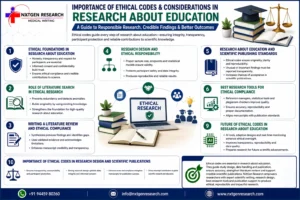
5.Research About Education and Scientific Publishing Standards
Scientific publishing requires researchers to follow ethical and professional standards throughout the research and publication process. Manuscripts should communicate original findings clearly while demonstrating methodological rigor, transparency, and reproducibility.
For example, unusual clinical presentations or uncommon treatment responses may be important findings in infectious disease research. Likewise, research about education should clearly explain the research problem, methodology, participant selection, findings, limitations, and implications.
NxtGen assists researchers in refining manuscripts to meet scientific publishing requirements. By combining scientific writing with structured literature review practices, we help scholars communicate their findings clearly and prepare manuscripts for editorial evaluation.
6.Best Research Tools for Ethical Compliance
Appropriate research tools can support researchers in maintaining accuracy, transparency, and ethical compliance. Reference management software, statistical analysis tools, plagiarism detection systems, and data management platforms can improve the organization and reproducibility of research.
For example, oncology studies may require accurate reporting of endpoints such as progression-free survival and adverse event grading. In research about education, researchers may use appropriate statistical and reference-management tools to analyze educational outcomes and maintain accurate documentation of previous studies.
NxtGen helps researchers organize manuscripts according to scientific publication standards. By improving the presentation of research findings and supporting clear scientific writing, we help scholars prepare manuscripts that are easier to evaluate and reproduce.
7.Scientific Research Data and Ethical Transparency
Ethical research depends on accurate, transparent, and responsibly managed scientific data. Researchers need to ensure that data are collected, stored, analyzed, and reported appropriately. Where applicable, researchers should also maintain participant confidentiality and comply with relevant regulatory and institutional requirements.
For example, cardiovascular studies may require reliable information on mortality and rehospitalization. In research about education, data may involve student performance, surveys, interviews, assessments, or other forms of participant information. Such data should be handled responsibly and presented accurately.
NxtGen helps researchers improve the clarity of statistical methodology and scientific reporting. By emphasizing reproducibility and ethical standards, we assist academics in presenting research findings in a credible and transparent manner.
8.Literature Review in Thesis and Ethical Reporting
A strong literature review is particularly important when ethical research is presented as part of a thesis. It provides the context needed to understand previous findings, identify knowledge gaps, and explain the originality of the proposed research.
For example, oncology researchers may need to examine previous studies on biomarker validation and therapeutic effectiveness before positioning a new study. Similarly, research about education should consider relevant theories, previous investigations, research methodologies, and existing evidence before presenting new findings.
NxtGen helps researchers structure manuscripts and thesis literature reviews according to scientific publication standards. By presenting previous research accurately and acknowledging relevant sources, scholars can strengthen the credibility and transparency of their work.
9.Future of Ethical Codes in Research About Education
The future of research ethics is likely to involve more advanced approaches to monitoring, transparency, and compliance. Emerging technologies such as AI-assisted compliance checks, real-time data monitoring, and advanced research analytics may support researchers in identifying potential ethical or methodological concerns.
In research about education, these developments could help researchers monitor data quality, improve research documentation, and identify ethical issues at different stages of a study. However, technological tools should complement rather than replace human judgment and established ethical principles.
NxtGen assists scholars in preparing scientific manuscripts that reflect emerging developments while maintaining established publication standards. Through scientific writing, literature search, and research design support, we help researchers present their work clearly and responsibly.
10.Importance of Ethical Codes in Research Design and Scientific Publications
Ethical codes and considerations are essential to responsible research because they promote transparency, accountability, participant protection, and scientific credibility. A strong research design should address informed consent, participant safety, data integrity, confidentiality, and appropriate methods of analysis.
A well-prepared literature review helps researchers understand existing knowledge and establish the context for their study. A comprehensive literature search also helps demonstrate that the research question is relevant and not simply duplicating previous work.
For research about education, ethical considerations are particularly important when studies involve students, teachers, institutions, or sensitive personal information. Researchers should clearly explain how participants are selected, how their information is protected, and how the collected data will be used.
NxtGen supports researchers by helping them organize literature reviews, refine scientific writing, and prepare manuscripts according to scientific publication requirements. These practices can strengthen research integrity and help researchers communicate meaningful findings to the academic community.
Conclusion
Ethical codes are an essential part of responsible research. They guide researchers in study design, participant protection, data management, analysis, reporting, and publication. In research about education, following ethical principles helps ensure that studies involving learners, educators, institutions, and other participants are conducted responsibly and transparently.
A comprehensive literature search and well-structured literature review can help researchers identify existing knowledge, avoid unnecessary duplication, and establish the relevance of their research. Clear scientific writing and accurate data reporting further strengthen the credibility of the final manuscript.
NxtGen supports researchers through scientific writing, literature review, research design, and manuscript refinement. By maintaining ethical standards and presenting research clearly, scholars can improve the quality, transparency, and credibility of their scientific publications and contribute meaningful knowledge to education, biomedical research, and evidence-based practice.
FAQs
1.What is the importance of ethical codes in research conduct?
Ethical codes promote transparency, credibility, accountability, and responsible research practices in research about education and scientific publications.
2.Why are ethical considerations important in scientific research?
Ethical considerations protect research participants, support the integrity of scientific findings, and ensure that research about education follows responsible research standards.
3.Why are ethics important in scientific writing and publication?
Ethical practices promote accurate reporting, help prevent plagiarism and research misconduct, and ensure that scientific publications follow accepted research standards.
4.How can researchers ensure ethical compliance while writing research papers?
Researchers can ensure ethical compliance by conducting a structured literature search, using an appropriate research design, maintaining data integrity, and following established ethical guidelines.
5.Why should researchers follow ethical guidelines in research?
Researchers should follow ethical guidelines to maintain credibility, improve the quality of literature reviews, protect research integrity, and support reproducible findings.
6.What happens if ethical codes are violated in research?
Violating ethical codes can lead to loss of credibility, questions about research findings, publication problems, retractions, and damage to trust in scientific research.