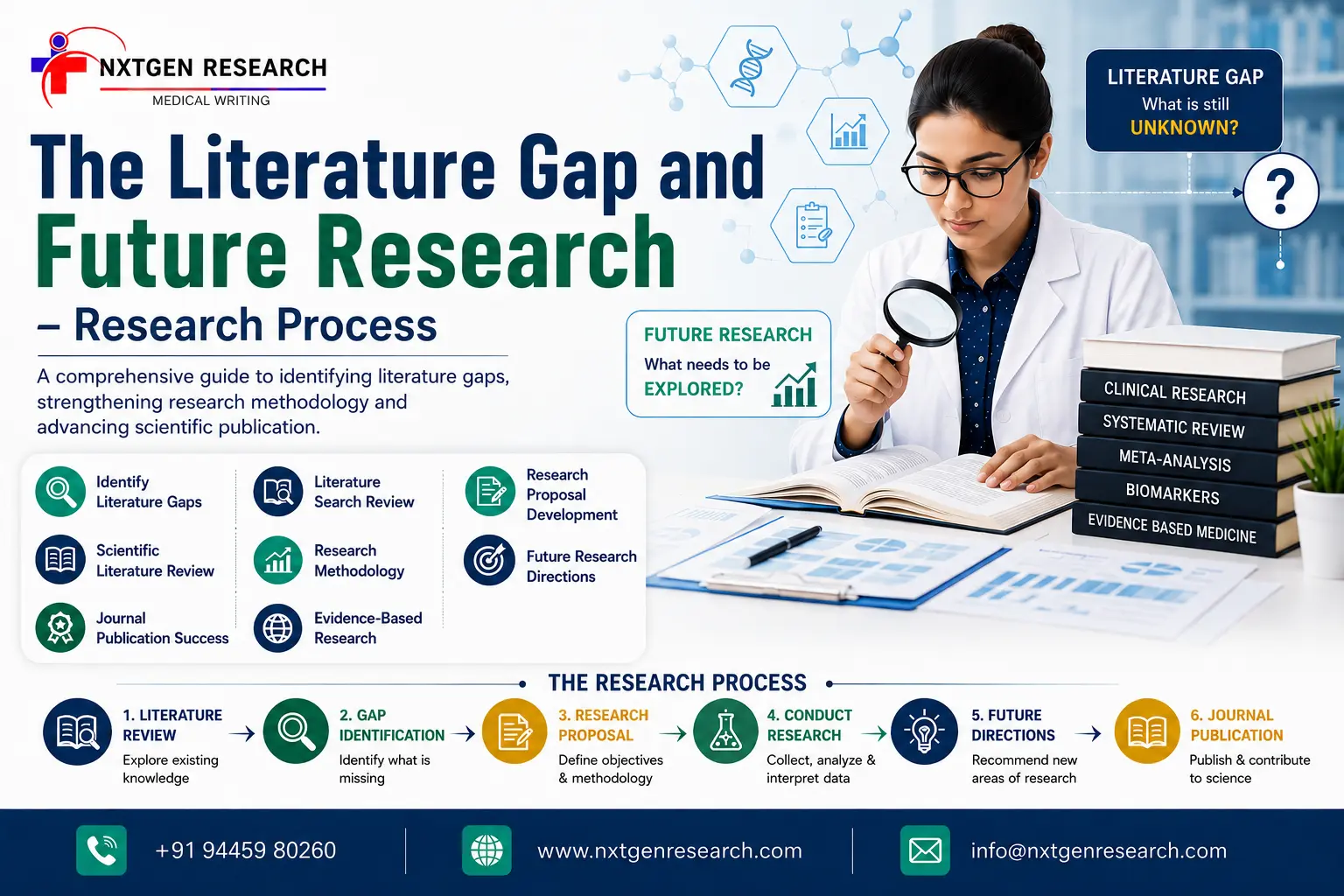
1. Understanding the Literature Gap in Research
A literature gap refers to an area of research that has not been sufficiently explored, explained, or addressed by existing studies. Identifying such a gap is an important part of developing a meaningful research project.
Researchers usually begin by reviewing existing studies, comparing their findings, and identifying unanswered questions. A well-structured medical literature review can help researchers understand what is already known and where further investigation may be needed.
For example, previous studies may provide considerable evidence about a particular treatment but offer limited information about its long-term effects. This difference can provide an opportunity for future research.
A clear understanding of the existing evidence helps researchers develop focused research questions and establish why their proposed study is necessary.
2. How a Literature Review Helps Identify Research Gaps
A literature review is more than a summary of previously published studies. It allows researchers to examine different findings, methodologies, populations, and limitations across the existing body of research.
While reviewing the literature, researchers can ask:
- What questions have already been answered?
- Which areas remain unclear?
- Are there conflicting findings?
- Have certain populations or settings been overlooked?
- Are existing research methods sufficient?
- What limitations have previous researchers identified?
These questions can help reveal a literature gap that deserves further investigation.
A systematic approach to reviewing previous research also helps researchers avoid repeating studies unnecessarily and provides a stronger foundation for developing their own research objectives.
3. Different Types of Literature Gaps
Research gaps can occur in several different forms. Understanding these categories can make it easier for researchers to identify an appropriate area for investigation.
A knowledge gap occurs when limited information exists about a particular subject. A methodological gap may arise when existing studies rely on similar methods and alternative approaches have not been adequately explored.
Researchers may also identify gaps related to:
- Population or demographic groups
- Geographic locations
- Research settings
- Theoretical approaches
- Time periods
- Conflicting findings
- Existing research methods
- Practical applications
For instance, research may have examined a health intervention extensively in adults while providing limited evidence involving older populations. This difference may represent a valuable area for future investigation.
4. Using Existing Research to Define a Research Gap
Identifying a gap requires careful evaluation rather than simply finding a topic that has not been studied before.
Researchers should examine the quality, scope, and limitations of existing publications. Comparing several studies can reveal patterns that may not be visible when examining individual papers separately.
For example, if multiple studies investigate the same clinical outcome but use different methodologies and report inconsistent results, further research may be needed to clarify the evidence.
Researchers should therefore connect the identified gap with a specific research problem. This creates a logical progression from the literature review to the research question, objectives, methodology, and expected outcomes.
5. Linking the Literature Gap to the Research Question
Once an area requiring further investigation has been identified, the next step is to develop a clear research question.
A strong research question should directly address the identified limitation or unanswered issue. It should also be specific enough to guide the research process.
For example, instead of asking a broad question about the effectiveness of a treatment, researchers could investigate whether the treatment produces different outcomes among a specific population or under a particular clinical condition.
This connection is important because the literature gap provides the justification for the research question. The proposed study should demonstrate how its findings could improve understanding of the subject or contribute additional evidence to the existing literature.
6. The Role of Research Methodology in Addressing a Gap
After establishing the research question, researchers need to select an appropriate methodology.
The research method should be capable of addressing the identified problem. Depending on the research question, this could involve qualitative research, quantitative analysis, observational studies, clinical research, systematic reviews, or other appropriate approaches.
Previous studies can also help researchers identify methodological limitations. For example, if earlier research relied on a small sample size or a limited geographical population, a new study could address these limitations through a broader research design.
A carefully selected methodology strengthens the connection between the identified gap and the proposed research.
7. Literature Gaps and Future Research Directions
One of the most valuable outcomes of a literature review is identifying opportunities for future research.
Researchers can examine the recommendations and limitations reported in previous studies to determine where additional investigation may be useful. However, future research should not simply repeat suggestions from earlier papers. Researchers should evaluate whether those recommendations remain relevant and whether new evidence has emerged.
Future research may focus on unexplored populations, alternative methodologies, longer follow-up periods, new technologies, or unanswered clinical and scientific questions.
This process allows researchers to build upon existing knowledge while making a distinct contribution to their field.
8. Using Evidence Synthesis to Strengthen Research Planning
Evidence synthesis can provide a broader understanding of what is already known about a research topic.
Systematic reviews and meta-analyses can help researchers identify consistent findings, limitations, methodological differences, and areas where evidence remains insufficient.
For example, if a systematic review finds that existing studies provide inconsistent evidence about a particular intervention, researchers can investigate why those differences occur and whether additional research is required.
Using evidence from multiple studies can therefore help researchers develop more focused research objectives and avoid making conclusions based on isolated findings.
9. From Literature Gap to Research Proposal
A clearly identified gap can become the foundation of a strong research proposal.
A research proposal should explain:
- The background of the research problem
- What previous studies have established
- What remains unanswered
- Why the issue requires further investigation
- The proposed research objectives
- The methodology that will be used
- The expected contribution of the study
The literature gap should be presented logically rather than simply stated. Researchers should demonstrate how the existing evidence leads to the proposed research problem.
Professional research and writing support can also help researchers improve the organization, clarity, methodology, and academic presentation of their proposals.
10. Moving From Research Gaps to Meaningful Contributions
Finding a research gap is only the beginning of the research process. The ultimate objective is to produce evidence that contributes something useful to the field.
A successful study may address an unanswered question, clarify conflicting findings, introduce a different methodology, examine an underrepresented population, or provide evidence that can support future research and practice.
Researchers should therefore consider the potential contribution of their work from the beginning of the project.
A well-defined research problem, appropriate methodology, transparent reporting, and clear interpretation of findings can help transform an identified gap into meaningful scientific knowledge.
Conclusion
Identifying a literature gap is an essential part of developing a focused and meaningful research project. By carefully reviewing existing studies, examining their findings and limitations, and identifying unanswered questions, researchers can determine where further investigation is needed.
The research process should then connect the identified gap with a clear research question, appropriate methodology, and achievable objectives. Evidence synthesis, critical evaluation of previous studies, and careful research planning can further strengthen this process.
Ultimately, addressing a well-defined gap allows researchers to move beyond summarizing existing knowledge and make a valuable contribution to their field. A strong connection between the literature review, research problem, methodology, and future research direction can provide a solid foundation for high-quality academic and scientific research.
FAQs
1. What is a literature gap in research?
A literature gap is an area where existing research provides limited evidence, leaves an important question unanswered, or has not adequately addressed a particular problem.
2. How do you identify a literature gap?
Researchers can identify gaps by critically reviewing existing studies, comparing findings, examining limitations, and looking for unanswered questions or under-researched areas.
3. Why is identifying a literature gap important?
It helps researchers establish the need for their study, develop focused research questions, and demonstrate how their work can contribute to existing knowledge.
4. What are the common types of research gaps?
Common types include knowledge, methodological, population, geographical, theoretical, evidence, and practical gaps.
5. How does a literature gap influence a research proposal?
The identified gap provides the justification for the proposed research and helps researchers develop appropriate objectives, research questions, and methodology.
6. How can researchers use literature gaps to identify future research?
Researchers can examine unanswered questions, conflicting findings, limitations, and recommendations from previous studies to develop relevant future research directions.